Trip planning · checklist
How to Plan Your First Ghost Town Road Trip: Beginner's Checklist
A step-by-step checklist for planning your first ghost town trip — routes, permits, timing, and what to bring.
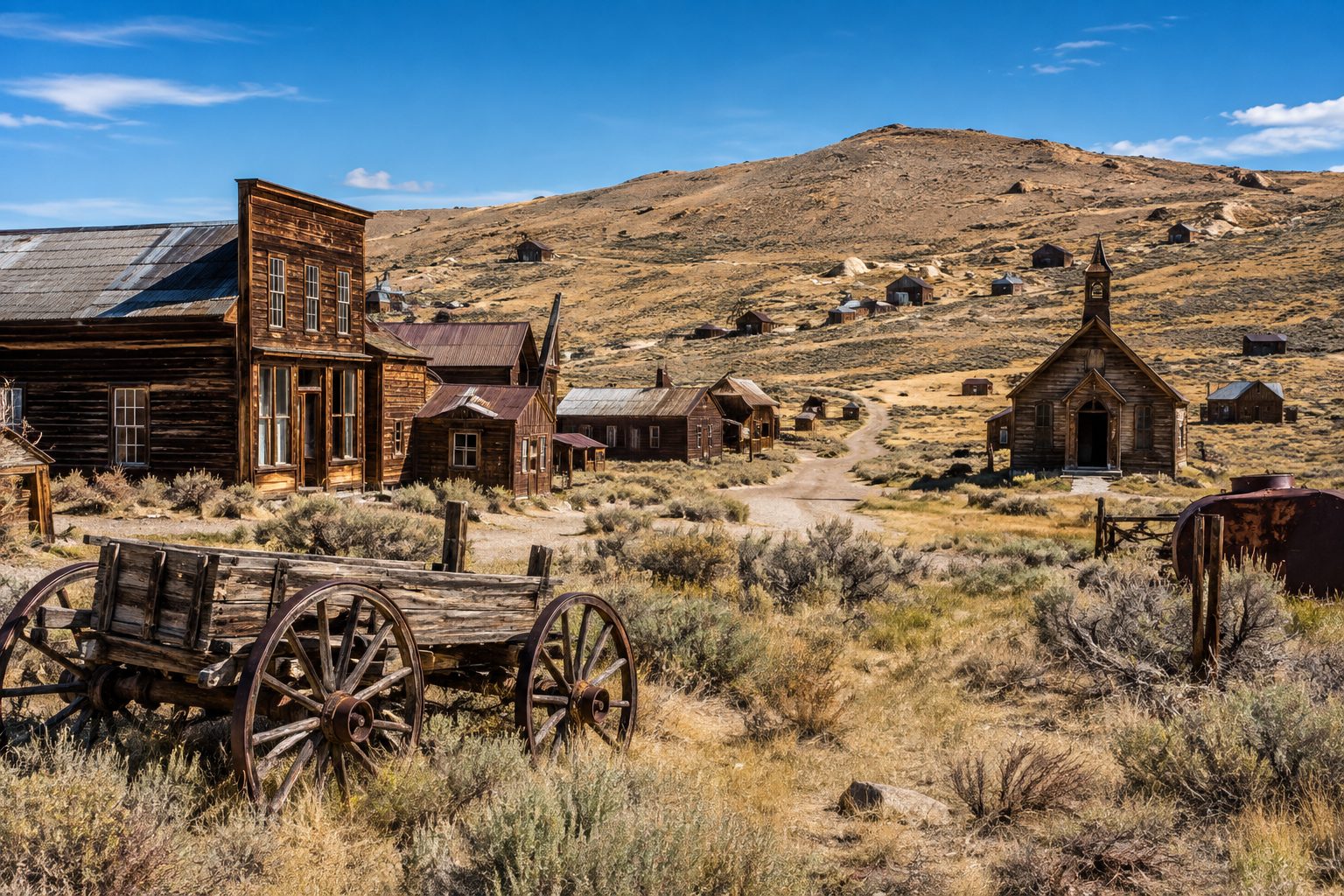
A ghost town road trip has one planning wrinkle most weekend trips don't: you're often driving toward a place with no gas station, no cell signal, and no one around if something goes wrong. None of that makes it complicated — thousands of first-timers do this safely every year — but it does mean "just Google it and go" isn't quite enough. This ghost town road trip checklist walks through everything to sort out before you leave, in order, using two real, very differently paced towns as reference points along the way.
Step 1: Pick a beginner-friendly town first
Not every ghost town makes a good first trip, and that's fine — save the remote ones for your second or third outing.
Calico, California is about as easy as a first ghost town trip gets. It's a San Bernardino County regional park about two hours from Los Angeles or Las Vegas, open daily with an entrance fee, with mine tours, shops, and camping on-site — genuinely described as the most family-friendly ghost town in California. If you want a low-stakes first trip with services available the whole time, start here.
Bodie, California is the other end of the beginner spectrum: a genuinely remote, unserviced state historic park at 8,375 feet, with no food or gas sold on-site and the final three miles on unpaved road. It's completely doable as a first trip — it's one of the most-visited ghost towns in the country — but it demands more of the planning below, and its access road is snowed in for much of the winter.
Either is a legitimate "first trip." The checklist below applies to both, but weigh more heavily toward the weather and supply sections if you're headed somewhere Bodie-like rather than Calico-like.
Step 2: Confirm access, hours, and legality
- Verify the land is open to the public and how. State parks, private tourist sites, and open public land all have different rules — our legal access guide breaks down the difference. Don't assume; confirm for the specific site.
- Check current hours and any entrance fee. Most managed sites (Calico and Bodie both) charge a day-use fee and operate on set hours — call or check the official park page the week of your trip, since both can change seasonally.
- Call ahead for road conditions if the site is remote or high-elevation. Bodie's own park office recommends calling before visiting, especially in winter or spring when the unpaved approach can turn to mud. Do this for any site reached by unpaved or high-elevation roads, not just Bodie.
Step 3: Check the season and weather — for the site, not just the day
- Rule out winter closure for high-elevation sites. Bodie sits above 8,000 feet and is accessible only by ski, snowshoe, or snowmobile once snow closes the road — check seasonal status before planning a trip there from late fall through spring.
- Rule out extreme heat for low-elevation desert sites. Many California and Nevada ghost towns, Calico included, sit in genuine desert; summer afternoon heat can be dangerous if you're not prepared for it. Early morning starts and a spring or fall trip are easier on first-timers than a July afternoon.
- Check the forecast for the specific day, including wind and flash-flood risk if your route crosses any desert washes — conditions at a remote townsite can differ sharply from conditions in the nearest city.
Step 4: Plan your route assuming zero cell service
- Download offline maps before you leave home. Once you're off the highway, cell coverage drops out fast in most ghost-town country — an offline map (downloaded in your maps app, or a dedicated GPS unit) isn't optional, it's how you avoid getting lost on unmarked dirt roads.
- Fuel up before the last town with a gas station, and assume the ghost town itself won't have one — neither Bodie nor most remote sites do.
- Check whether the final approach needs high clearance. Bodie's last three miles are unpaved; many other ghost towns require genuine 4WD. Know your vehicle's limits before you're committed to a road with nowhere to turn around.
- Tell someone your route and expected return time. This costs nothing and is the single most useful safety step for any remote trip, ghost town or otherwise.
Step 5: Budget your time like you won't have daylight to spare
- Plan to arrive near opening, not mid-afternoon. This buys you the most flexible daylight, avoids the worst heat at desert sites, and gives you a buffer if the drive takes longer than expected.
- Work backward from sunset, not forward from your start time. Unpaved and unlit access roads are a different experience after dark than they are at 9am — build in enough margin that your return drive happens in daylight, especially for a first trip.
- Add real time for the drive itself, not just the map estimate. Unpaved final stretches, like Bodie's last three miles, take longer than GPS travel-time estimates assume — pad your schedule rather than cutting it close.
Step 6: Pack for a place with no services
- Water — more than you think you need, especially for desert sites in warm months. A common baseline is one gallon per person per day for anything beyond a quick visit; bring extra if you're hiking around the site.
- Cash. Some sites, Bodie included, recommend bringing cash alongside a card, since card systems aren't guaranteed at a remote entrance station.
- Closed-toe, sturdy shoes. Ghost towns are full of rusted metal, broken glass, and uneven ground — sandals are a genuinely bad idea here, not just an inconvenience.
- Layers, even in summer. Desert temperature swings between morning and afternoon (or elevation changes at a place like Bodie) can be large enough to catch first-timers off guard.
- Sun protection, a basic first aid kit, and a paper map as backup to your phone's offline map.
- A flashlight, even for a daytime visit — some structures and mine-adjacent areas are dim even at midday.
Step 7: Know the etiquette before you arrive
- Read up on what's actually legal and expected on-site before you go, not after — our ghost town etiquette guide covers this in full, but the short version: take photographs, leave everything exactly where you found it, and stay out of unstabilized buildings.
- Plan to pack out your own trash. Remote sites rarely get regular cleanup.
Quick-print packing list
Everything from Step 6, in one scannable list you can screenshot or print before you head out the door:
- Water (1+ gallon per person, more in warm months)
- Cash, in addition to a card
- Closed-toe, sturdy shoes
- Layers for temperature swings
- Sun protection (hat, sunscreen, sunglasses)
- Basic first aid kit
- Paper map as backup to your phone
- Flashlight
- Offline maps downloaded before you lose signal
- Full tank of gas
- A trash bag to pack out what you bring in
Two real first-trip plans
A Calico day trip: Fuel up in Barstow, arrive at opening to beat both the heat and the crowds, budget a half-day for the mine tour and main street, bring cash for the entrance fee and any shops, and treat the drive itself (easy, paved, off I-15) as the low-stress part of the day.
A Bodie day trip: Check road status by phone before you leave, especially outside summer; fill your tank in Bridgeport or Lee Vining, the nearest towns with gas; pack water, food, and cash since none of it is available on-site; expect the final three miles to be slow and unpaved; and budget for cool temperatures and wind even in summer, given the elevation.
What separates a smooth first trip from a frustrating one
Almost every bad first-ghost-town-trip story comes down to the same handful of avoidable gaps: showing up to a closed gate because hours weren't checked, running low on gas or water with no services for miles, relying on a phone map that stops working the moment signal drops, or arriving in sandals to a site full of rusted metal. None of these require expert-level preparation to avoid — they just require going through this checklist once before you leave the driveway.
Frequently asked questions
- Do I need a 4WD vehicle to visit a ghost town?
- Not always. Managed sites like Calico are fully paved. Others, like Bodie's final three miles, are unpaved but usually passable in a standard vehicle in good weather — though high clearance is genuinely necessary at many more remote sites. Check the specific site's access notes before you go.
- Is one day enough for a first ghost town trip?
- Yes, for either town covered here. Calico and Bodie are both comfortably doable as a single day trip from a nearby city, with Bodie requiring an earlier start given the drive and elevation.
- What's the single most important thing to pack?
- Water, without a close second — especially for any desert site in warm months, where dehydration is the most common way a fun day trip turns into a genuinely bad one.
- Can I bring my dog?
- At some sites, yes — Bodie allows leashed dogs, for example — but rules vary by site and it's worth confirming before you go, especially at sites with mine hazards or wildlife concerns. Check the specific town's record or official page rather than assuming.
Ready for more than one trip? Join Ghost Town Society
Planning gets easier once you're not starting from zero each time. Ghost Town Society membership ($10/year) gets you a trip passport that stamps at every town you check into, field badges as you explore different categories of sites, photo uploads with attribution, and an ad-free site. If you're planning to make this a habit rather than a one-off, Society Pro ($40/year) adds historic USGS topographic maps with swipe comparisons against current terrain, land-status overlays (BLM, Forest Service, state park boundaries), a private field log for your own notes and pins, and access to the full mine and lost-location database behind this site's records. Join Ghost Town Society before your next trip and plan your route with the same maps we use to build these guides.