The story
Bodie is the benchmark American ghost town. Gold was found here in 1859, but the real boom came after 1876, when the Standard Company hit a rich vein. By 1879 roughly 8,000 people lived at 8,400 feet in the high desert east of the Sierra Nevada, supporting around 60 saloons and a reputation as one of the roughest mining camps in the West.
The rich ore didn't last. Mining declined through the 1880s and the town shrank for the next fifty years. Fires in 1892 and 1932 took out most of the business district, and the post office closed in 1942.
California made what was left a state historic park in 1962 with a policy it calls arrested decay: the buildings are stabilized but never restored. About 110 structures survive, and many interiors were simply left as they were — furniture in the houses, goods on the store shelves, lessons still on the schoolhouse board.
What remains today
About 110 original buildings, including the Methodist church, the schoolhouse, the Standard Mill, and houses with intact interiors. Widely considered the best-preserved ghost town in the United States.
Society Pro
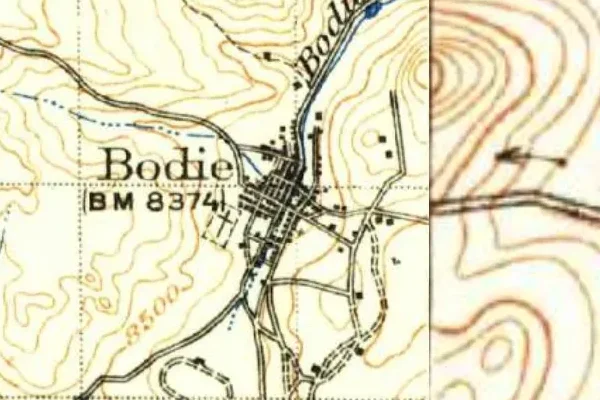
Bodie on the old USGS survey, and what the record holds around it
Within five miles the record maps 544 mine shafts, adits and prospect pits, 26 named mineral sites, 10 lost places and 3 cemeteries. Pro puts them on the map with the 1879–1919 survey underneath and a swipe to today.
From the archives
![[Masonic Hall, Bodie, California]](https://tile.loc.gov/storage-services/service/pnp/cph/3c10000/3c14000/3c14300/3c14312_150px.jpg#h=120&w=150)
[Masonic Hall, Bodie, California]

Bodie is a ghost town in the Bodie Hills east of the Sierra Nevada mountain range in Mono County, California

Bodie is a ghost town in the Bodie Hills east of the Sierra Nevada mountain range in Mono County, California

Bodie is a ghost town in the Bodie Hills east of the Sierra Nevada mountain range in Mono County, California
Bodie turns up on 63,127 digitized newspaper pages from California — read them free in the Library of Congress's Chronicling America collection.
Source: Library of Congress digital collections.
Questions from the field
- Is Bodie worth visiting?
- Bodie is widely considered the best ghost town in America — about 110 buildings preserved in arrested decay with interiors intact. Most visitors spend two to three hours; photographers spend the day.
- When is Bodie open?
- Year-round in principle, but Bodie Road typically closes with snow from roughly December through April, when access is by snowmobile or ski only. Summer hours run about 9–6.
- What is the 'Bodie curse'?
- Park lore says items stolen from Bodie bring bad luck until returned — rangers regularly receive mailed-back nails and shards with apology letters. Curse or not, removing anything is illegal.
From the field
The most valuable part of this record is the part only visitors can write.
Stamp your passport
Check in at Bodie — GPS-verified visits earn an inked stamp.
File a field report
Road conditions, what's still standing, what's gone — your report joins the record.
Add photographs
Credited, dated, and preserved as part of Bodie's permanent record.
No field reports yet — sign in to file the first.
Primary sources for this record
- — USGS GNIS feature 1658094
- — California State Parks — Bodie SHP
- — Bodie Foundation