Field guide · access
Is It Legal to Visit Ghost Towns? Access Rules by State
Public land, private property, permits — what you need to know before visiting a ghost town legally and safely.
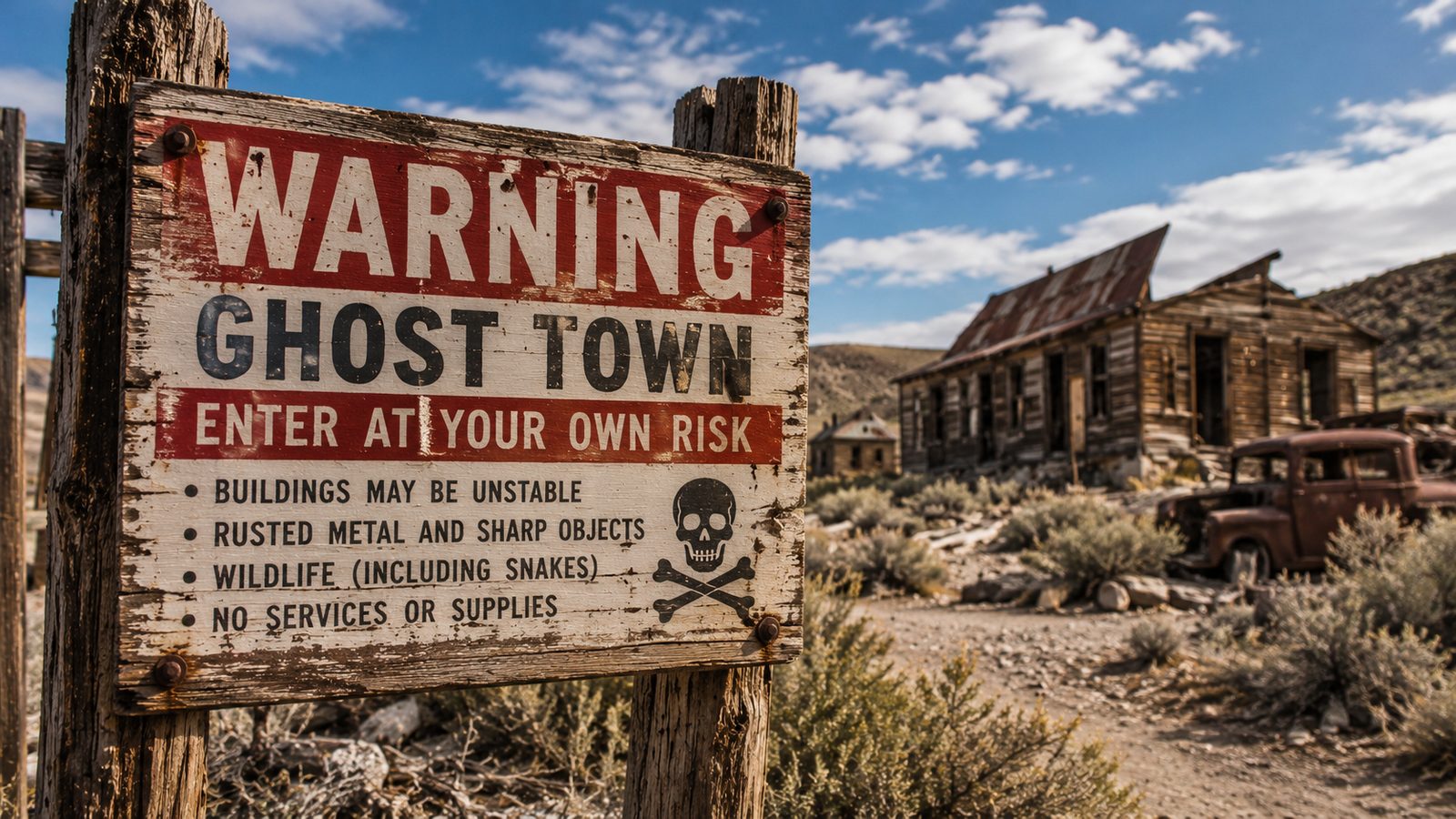
Short answer: usually yes, but it depends entirely on who owns the ground you're standing on. Every ghost town in America still belongs to someone — a state park system, a private landowner, a federal agency, or in some cases a family that's owned the townsite for generations. That ownership, not the fact that a place is abandoned, is what determines whether you're a legal visitor or a trespasser.
This page walks through how to tell the difference, what's actually allowed once you're there, and how the rules shift from state to state and site to site — using three real, very differently managed ghost towns as working examples.
A note before you go: Access laws, land status, and site hours change — sometimes without much notice. A road that was open BLM land last year can become a mining claim this year; a state park can change its fee structure or hours seasonally. Treat everything on this page as a starting point, not a substitute for checking the official current source (state park website, BLM field office, or county land records) before you plan a trip or take any action on-site.
The short answer: it depends on who owns it
"Abandoned" is not the same as "unowned." A townsite with no residents can still sit on land that's actively managed by a state parks department, leased as a mining claim, owned outright by a private family, or held by the federal government as public land. Each of those ownership types comes with a different set of rules — and the physical condition of a place (whether it's fenced, gated, or posted) is often your fastest clue to which situation you're in. A fence or a "No Trespassing" sign overrides anything else you've read online, including this page.
The four kinds of ghost town ownership you'll encounter
State or federal historic site. Some of the best-known ghost towns have been formally preserved and are managed like any other park — open during set hours, often with an entrance fee, and with rules posted on-site. Bodie, California is the clearest example: it's been a California State Historic Park since 1962, maintained in a deliberate state of "arrested decay," with defined visiting hours and a day-use fee. Visiting is straightforwardly legal here — you're a paying park guest, not a trespasser — but the park's own rules (no relic hunting, stay on marked paths, no entering unstabilized buildings) still apply in full.
Privately owned and operated as a tourist site. Some ghost towns are owned outright by a private party who chooses to open them to the public, usually for an admission fee, similar to a private museum. Vulture City, Arizona works this way — it's private property operated on seasonal open days with paid admission and both self-guided and guided tour options. Visiting is legal because the owner has explicitly invited the public in, but you're bound by whatever hours, fees, and site rules the operator sets, and showing up outside open hours or off the marked tour path is trespassing on private land, full stop.
Living or mixed towns. Some places on ghost-town lists aren't fully deserted — they have a small year-round population living alongside abandoned buildings, and property lines run right through the middle of the historic district. Chloride, Arizona is a good example: it's a living town of roughly 250 residents where galleries and public art areas welcome visitors, but plenty of surrounding land is private. The rule here is the most important one on this entire page: never assume open access just because a building looks abandoned. Residents' homes and private lots are not part of the tour, even if they sit next to a historic storefront that is.
Open public land. A large share of America's ghost towns — especially smaller mining camps and townsites — sit on land managed by the Bureau of Land Management (BLM), the U.S. Forest Service, or a state land agency, with no gate, no fee, and no ranger on-site. Access is generally legal and free, but "open" doesn't mean "unregulated": campfire restrictions, seasonal closures, off-road vehicle rules, and abandoned mine hazards are all still enforced, and boundaries between public and adjacent private or claimed land are frequently unmarked.
What's actually legal to do at a ghost town
Ownership tells you whether you're allowed on-site. This section covers what you're allowed to do once you're there — because the two are governed by different rules, and this is where most well-meaning visitors accidentally break the law.
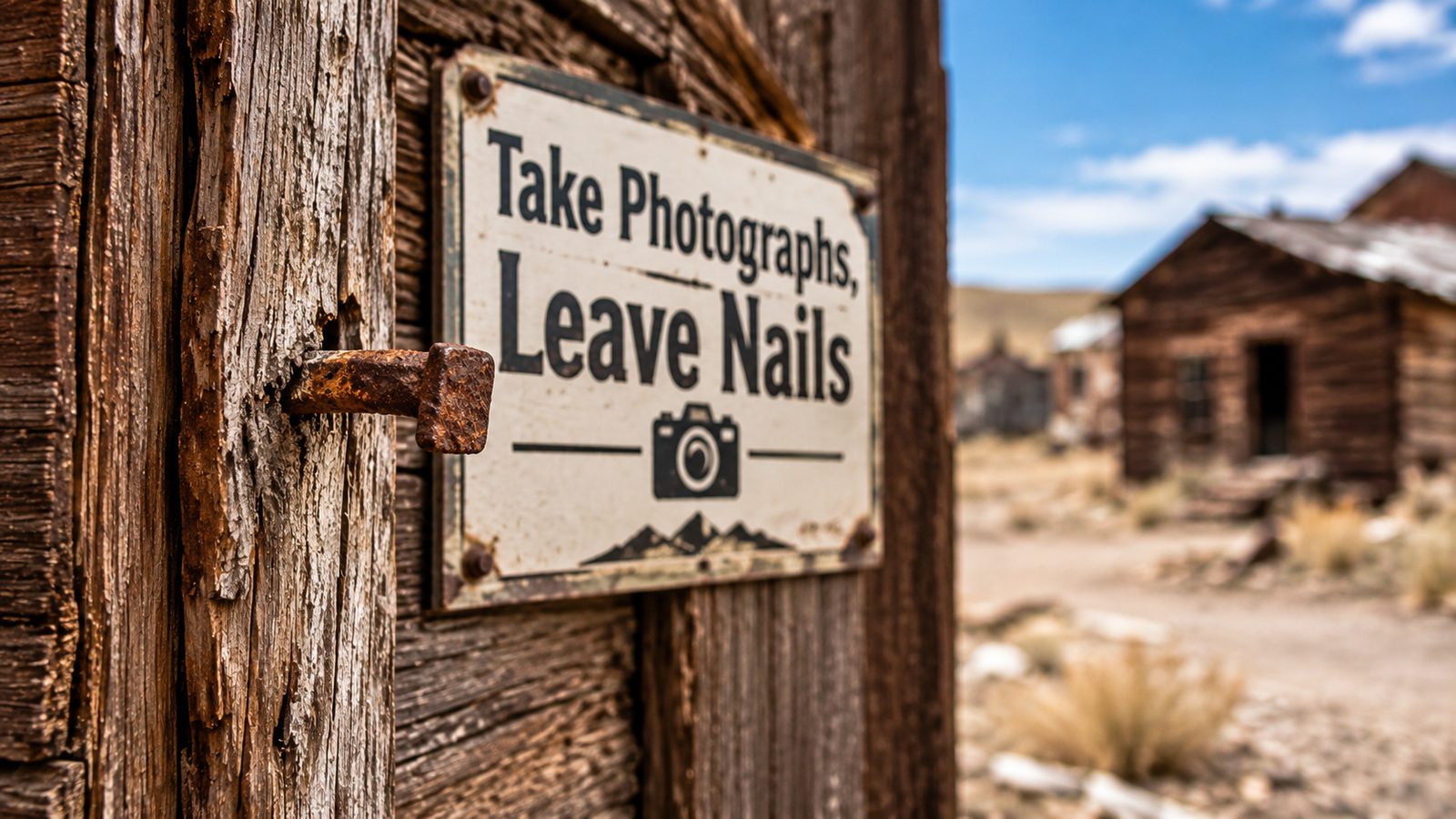
Photography: yes, essentially everywhere. Taking pictures of buildings, ruins, and landscapes is legal at nearly every ghost town, public or private, and is the lowest-impact way to document a site. Ask before photographing identifiable people, especially in living towns like Chloride, and check individual site rules before flying a drone (see below).
Walking public areas: yes, if you stay on them. Marked paths, streets, and designated visitor areas are fair game. Wandering off-trail onto adjacent private parcels, into fenced-off sections, or through areas marked closed is not — even if there's no visible barrier.
Entering structures: usually restricted, for safety as much as legality. Many ghost-town buildings have stood for over a century without maintenance. Floors collapse, roofs fail, and stairs give way. Most managed sites explicitly prohibit entering unstabilized buildings, and even where it's not posted, this is one case where "legal" and "safe" line up — don't do it.
Removing artifacts: illegal almost everywhere, and federally enforced. This is the single most important legal rule on this page. On federal and Indian land, the Archaeological Resources Protection Act (ARPA) makes it a federal crime to excavate, remove, or traffic archaeological resources without a permit — penalties scale up to two years imprisonment and $20,000 in fines for a first offense, and far more for damage to protected sites. On state and private land, removing an artifact is simple theft under state law. The site's own rule of thumb applies everywhere: take photographs, leave nails.
Metal detecting: heavily restricted, and it's not a blanket "yes" anywhere near a ghost town. It's prohibited in national parks and most National Historic Landmarks outright, restricted or permit-gated on most BLM and Forest Service land near historic or archaeological sites, and only potentially legal on private land with the explicit permission of the owner. Because most ghost towns are, by definition, historic or archaeological sites, assume metal detecting is off-limits unless a specific site tells you otherwise in writing.
Flying drones: restricted at most managed sites. Drone flights are banned entirely within National Park Service units and are frequently restricted over state parks and near other visitors on any land type. Even where it's technically allowed (some open BLM land), FAA rules on altitude and visual line of sight still apply, and flying over private property, including living towns, without permission raises separate privacy and trespass issues.
Camping and overnight stays: often fine on public land, rarely fine at private or park sites. Dispersed camping is commonly allowed on BLM and Forest Service land near ghost towns, usually with a stay-length limit. It's typically not permitted at state historic parks like Bodie outside designated campgrounds, and never permitted at privately operated sites like Vulture City without explicit arrangement.
Off-road driving: stay on designated routes. Cutting new tracks across open desert or grassland to reach a townsite is both illegal on most public land and damaging to the same historic landscape you came to see.
How access rules vary by state
The ownership categories above hold everywhere, but how common each one is — and how strictly it's enforced — shifts by state:
California leans heavily on its state park system for its best-known ghost towns, which means clearer signage, set hours, and consistent enforcement, but also entrance fees and firmer restrictions on off-trail access.
Nevada has enormous stretches of BLM land, so a larger share of its ghost towns sit on open public land with no gate or fee — but active and historic mining claims are common and often unmarked, so a site that looks like open desert can still be privately claimed ground.
Arizona mixes all four ownership types heavily within short distances, as Chloride and Vulture City illustrate — living towns, private tourist operations, and open desert can sit within a few miles of each other, so verifying each specific site matters more here than almost anywhere else.
Colorado has a significant number of ghost towns above 9,000 feet on Forest Service land, where seasonal road closures (not just ownership) determine whether a site is reachable at all for much of the year.
Utah and Texas both have large amounts of state trust land mixed among ghost town sites, which functions differently from BLM land and can require a permit for some activities even when the land appears open.
This is a general pattern, not a legal guarantee for any specific site — state and county rules change, and the only reliable check is the official current source for the exact site you're planning to visit.
Three towns, three very different rules
Bodie, California — Legal and straightforward: a state historic park with posted hours, a day-use fee, and clear on-site rules. The main risk here isn't accidental trespassing, it's ignoring posted restrictions on structures and artifacts inside a well-monitored park.
Vulture City, Arizona — Legal during posted seasonal hours as a paying visitor on private land; illegal outside those hours or off the marked tour route. Always confirm current open days before driving out, since hours shrink seasonally.
Chloride, Arizona — Legal in the public gallery and art areas of this living town; illegal (and simply rude) anywhere that crosses into a resident's private property, even without a visible fence. This is the example that best illustrates why blanket answers don't work for mixed-ownership towns.
Frequently asked questions
- Is it illegal to visit a ghost town without permission?
- It depends on ownership, not on whether the town is abandoned. State and federal historic sites are legal to visit as a member of the public during open hours. Private ghost towns are legal to visit only with the owner's permission, whether that's an admission ticket at a site like Vulture City or direct landowner consent elsewhere.
- Can you get arrested for visiting a ghost town?
- Trespassing on posted or fenced private land can result in citation or arrest depending on the state and county. Removing artifacts from federal or state land can result in federal or state criminal charges under laws like ARPA. Simply walking through an open, unposted public-land townsite is not something people are typically arrested for.
- Do I need a permit to visit a ghost town?
- Most don't require one. Some do — certain BLM or Forest Service access roads, some state trust land, and a handful of specific historic sites require advance permits or reservations. Check the specific site's official page before you go, especially for anything on state trust land.
- Is it legal to take photos at a ghost town?
- Yes, essentially everywhere you're legally allowed to be. Photography is the one activity that's consistently permitted across all four ownership types covered on this page.
Help keep this guide accurate
Access rules change, gates go up, and hours shift with the seasons — if you've visited a site recently and found the access situation different from what's described here or in a town record, submit a field report and help keep this guide current for the next visitor.