Field conduct · leave no trace
Ghost Town Etiquette: Leave No Trace and Responsible Exploring
Simple rules for visiting ghost towns without damaging what's left — for explorers who want these places to last.
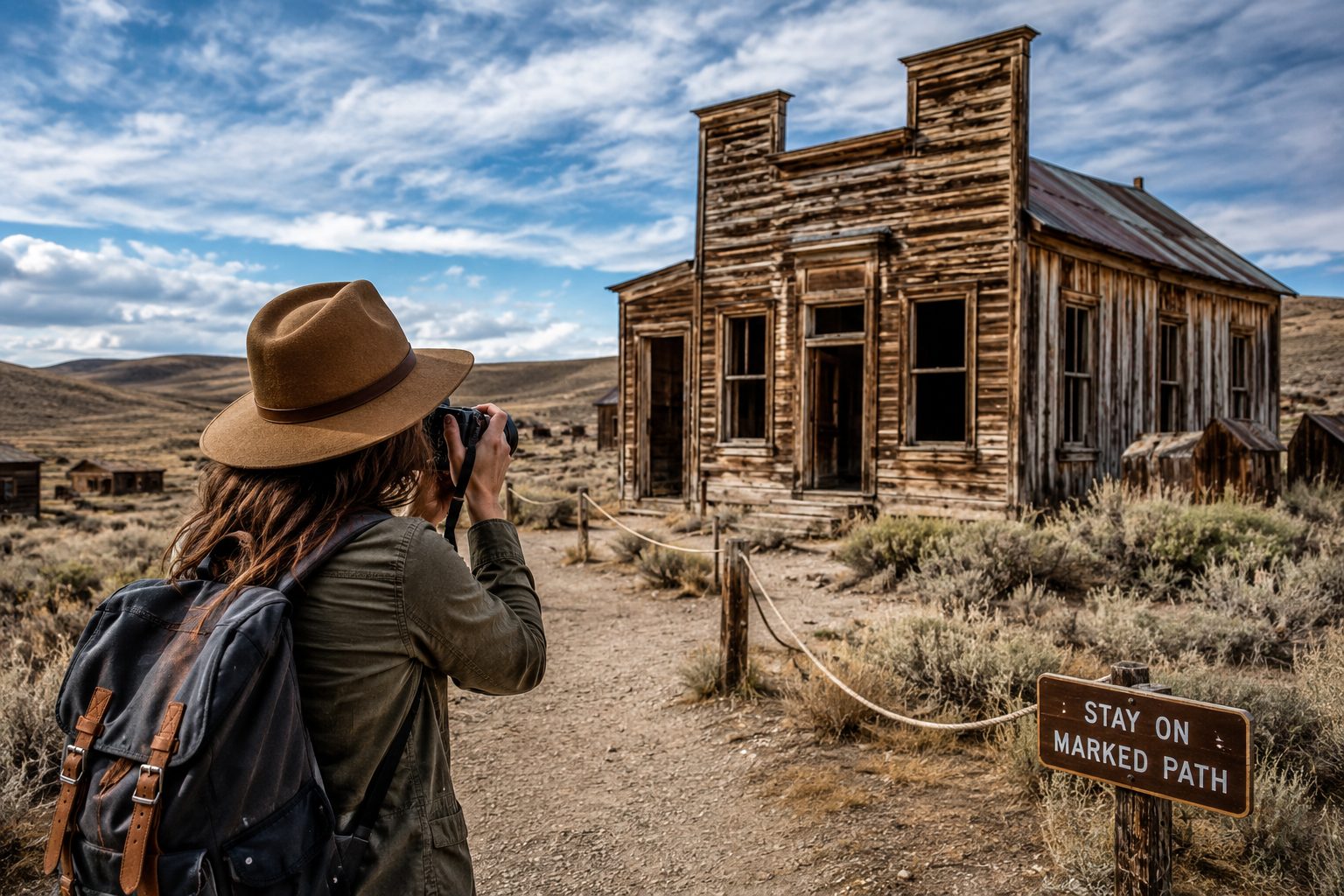
Ghost town etiquette starts from a different premise than ordinary wilderness Leave No Trace. In a forest, a footprint fades and a trampled patch of grass grows back next season. In a ghost town, nothing grows back. A doorframe someone pries a square nail out of stays missing that nail forever. A collapsed floor doesn't rebuild itself. Every visitor who comes after you sees exactly what you left behind — or exactly what you took.
That's the standard this page works from: not just "leave no trace," but leave no permanent loss. It matters more now than it used to — as ghost town exploring grows as a hobby and more visitors show up with cameras, drones, and detailed directions pulled from sites like this one, the cumulative effect of small individual choices adds up faster than it did when these places were harder to find. Below are the ground rules, what's actually legal at most sites, and two real towns — one a managed park, one a private restoration — that show how differently "responsible" can look depending on where you are.
Before you go: Access rules, land status, and site hours change by state and even by season, sometimes without much notice. Treat every rule on this page as a starting point, not a substitute for checking the official current source for your specific destination before you travel or take any action on-site.
Why ghost towns need their own set of rules
Standard Leave No Trace guidance was built for natural landscapes that can absorb some human impact and recover. Historic sites can't. A ghost town is a finite, non-renewable resource in the truest sense — once a structure collapses or an artifact leaves the property, that piece of the historical record is gone, not just for you but for every future visitor and every historian who might have studied it. That's why "take photographs, leave nails" has become the closest thing this hobby has to a universal rule: it's Leave No Trace adapted for places that don't get a second growing season.
What's legal and what's allowed
Ownership determines what's legal at any given site — a state historic park, a privately operated site, and open public land all carry different rules (our full legal guide covers this in depth). A few things hold true almost everywhere, though:
Photography is legal essentially anywhere you're allowed to be. It's the lowest-impact way to document a site, which is exactly why it's the centerpiece of good etiquette rather than an afterthought.
Removing artifacts is illegal at most sites, and federally enforced on public land. The Archaeological Resources Protection Act (ARPA) makes it a federal crime to excavate or remove archaeological resources from federal or Indian land without a permit. On state and private land, taking something is simple theft under state law. There's no version of "just this one nail" that's actually legal.
Entering unstabilized structures is usually restricted, and it's the rule visitors break most. Many buildings have stood unmaintained for a century or more; floors, stairs, and roofs fail without warning. Most managed sites prohibit this explicitly — treat it as a hard rule everywhere, posted or not.
Metal detecting is off-limits at most sites you'd actually want to visit. It's banned outright in national parks and most historic landmarks, and restricted or permit-gated on BLM and Forest Service land near historic sites — which describes the overwhelming majority of ghost towns.
Drones and overnight camping depend entirely on the specific site. Drone flights are banned within National Park Service units and frequently restricted at state parks; camping is often fine on open BLM land near a townsite but rarely permitted at managed parks or private sites without prior arrangement. Neither has a single blanket answer — check the specific site before you plan around either one.
Seven ground rules for responsible exploring
- 1.Verify before you go. Confirm land ownership, current hours, and any permit requirements before you drive out — not after you're already standing at a locked gate or on someone's private claim. This is the single step that prevents most accidental trespassing, and it takes minutes against a site's official page or a quick call ahead.
- 2.Stay on established paths and roads. Cutting a new track across open desert or grassland to reach a townsite damages the same landscape you came to see, and it's illegal on most public land regardless of intent.
- 3.Pack out everything you bring in. Trash, food waste, and anything else you carried in leaves with you — remote sites rarely get regular cleanup, and litter left at a ghost town has nowhere else to go.
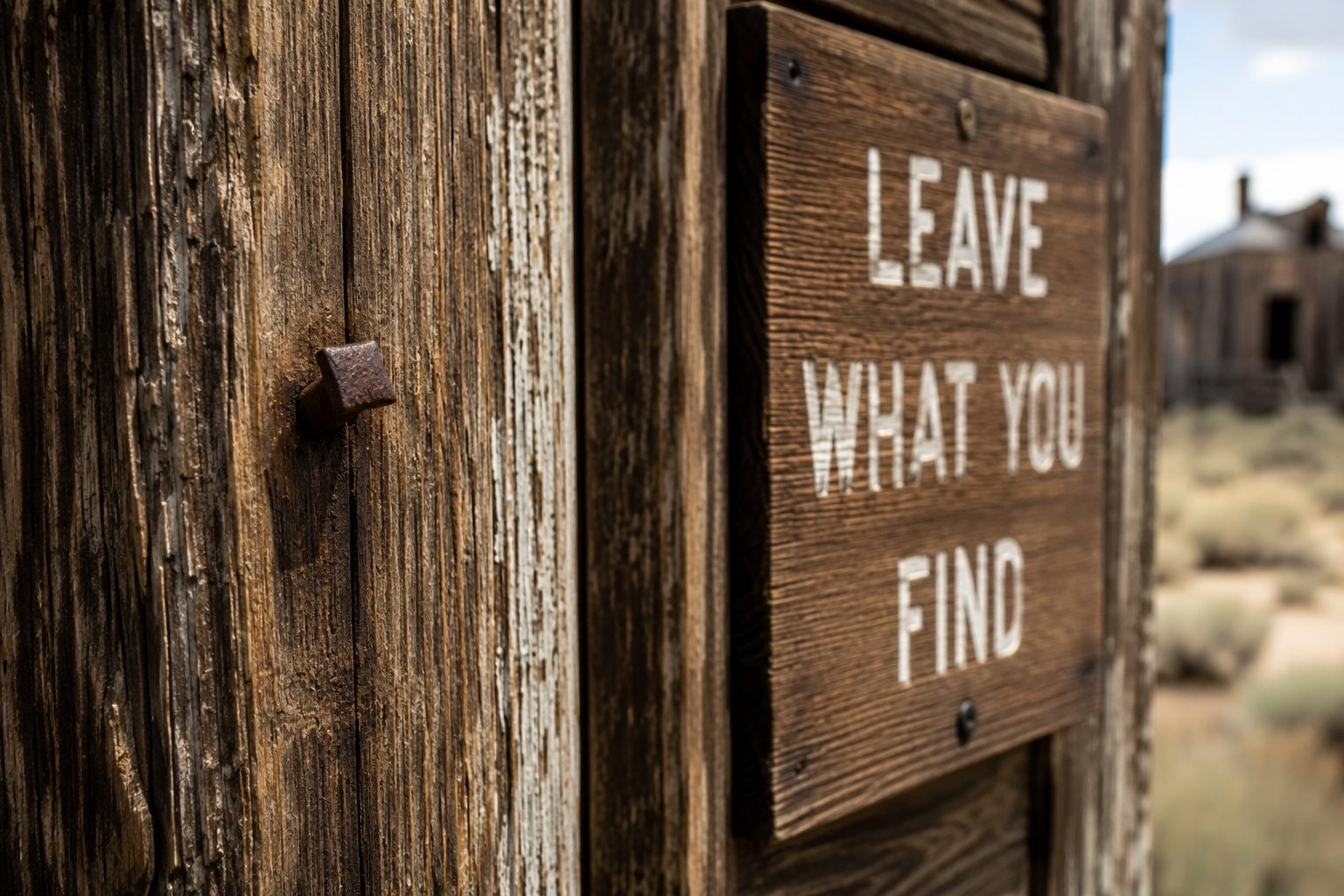
- 4.Leave what you find, always. Artifacts, structural fragments, even small things that look like scrap — they're part of the historical record, not souvenirs. Take the photograph; leave the object exactly where it was.
- 5.Treat fire risk as absolute, not situational. Most ghost town structures are a century-old timber, standing in open, often drought-prone country — the fastest way to erase a site permanently. Fires at Bodie in 1892 and 1932, and a 2020 fire that destroyed Cerro Gordo's American Hotel before it was rebuilt, are reminders that this isn't hypothetical. Skip open flames near any structure entirely.
- 6.Respect both residents and wildlife. Some "ghost towns" are living communities with private homes mixed among historic buildings — never assume a building is fair game just because it looks abandoned. Abandoned structures and mine openings also attract wildlife, including species you don't want to surprise in a dark building; give both people and animals their space.
- 7.Be considerate of other visitors and site owners. Ghost towns are increasingly popular, and many sites — especially small, privately run ones — depend on visitors following posted expectations to stay open at all. Showing up unannounced, ignoring tour boundaries, blocking narrow access roads, or crowding a small site changes access for everyone who comes after you. A site that gets a reputation for unruly visitors is a site that's more likely to close, gate off, or restrict access the next season.
Two towns, two ways to do this right
Bodie, California is the managed-park model. As a California State Historic Park maintained in a deliberate state of "arrested decay" since 1962, Bodie has posted hours, marked paths, and clear on-site rules — responsible visiting here mostly means following what's already posted: stay on paths, stay out of unstabilized buildings, and leave everything exactly where you found it.
Cerro Gordo, California is the opposite model, and a useful contrast. It's private property under active restoration, reachable only by an eight-mile unpaved road, with tours, volunteer days, and overnight stays offered periodically by arrangement. The site's own guidance is blunt about the one rule that matters most here: don't drive up unannounced. Responsible visiting at a working restoration project means respecting that it's someone's ongoing work, not a static exhibit — you're a guest on private land, not a park visitor with standing access rights. That distinction matters practically, too: Cerro Gordo's current owner has spent years and real money restoring buildings like the American Hotel, and an eight-mile unpaved approach road means a poorly planned visit isn't just rude, it can strand you.
Frequently asked questions
- Is it rude to take a small souvenir from an abandoned building?
- Yes — and on federal or state land, it's also usually illegal, not just impolite. A single removed object rarely looks significant on its own, but every ghost town's condition today is the sum of thousands of visitors each taking "just one thing."
- Can I use a drone to photograph a ghost town?
- Sometimes, but check first. Drones are banned within National Park Service units, frequently restricted at state parks, and raise separate privacy concerns at living towns or near other visitors — confirm the specific site's rules before flying.
- What should I do if I find something that looks historically significant?
- Photograph it, note its location, and leave it in place. If the site has a records or field-report system, reporting what you found (without moving it) helps document the site for researchers far more than removing it ever could.
- Is it okay to visit a ghost town alone?
- Legally, usually yes, but it's worth thinking about separately from etiquette. Many sites are remote with no cell service, and hazards like open mine shafts and unstable floors are real — solo visits are common in this hobby, but telling someone your route and expected return time costs nothing and matters if something goes wrong.
Help us keep this guide — and every record — accurate
Etiquette only works as a shared standard if the information behind it stays current. If you've visited a site recently and noticed access rules, hazards, or conditions that don't match what's described here or in a town's record, submit a field report — it's how this site stays accurate for the next visitor, and how responsible exploring scales as more people discover these places.