The story
Mercur matters to mining history far beyond Utah: it was here in the 1890s that cyanide leaching was first proven at industrial scale in America, unlocking low-grade gold ores worldwide. Five thousand people lived in the canyon at the 1900 peak — including the young mining engineer Daniel C. Jackling, who later revolutionized copper at Bingham.
The 1902 fire leveled the business district; rebuilt, the town died with the ores by 1913. A 1980s open-pit operation then consumed the townsite itself — Mercur is a ghost town whose very ground was processed. Only the hillside cemetery, above the pit workings, survives.
What remains today
The cemetery and interpretive marker; the townsite proper is reclaimed mine benches behind a locked gate.
Society Pro
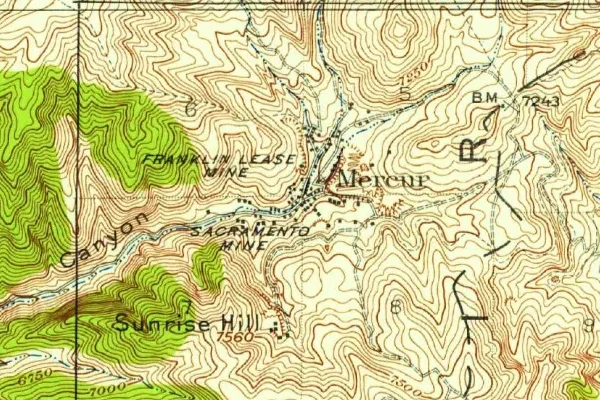
Mercur on the old USGS survey, and what the record holds around it
Within five miles the record maps 467 mine shafts, adits and prospect pits, 178 named mineral sites, 1 lost places and 3 cemeteries. Pro puts them on the map with the 1879–1919 survey underneath and a swipe to today.
From the archives

Mercur turns up on 32,602 digitized newspaper pages from Utah — read them free in the Library of Congress's Chronicling America collection.
Source: Library of Congress digital collections.
Questions from the field
- Why is nothing left of Mercur?
- A modern open-pit gold mine in the 1980s–90s excavated the historic townsite itself. The pioneer cemetery on the slope above is the sole survivor.
From the field
The most valuable part of this record is the part only visitors can write.
Stamp your passport
Check in at Mercur — GPS-verified visits earn an inked stamp.
File a field report
Road conditions, what's still standing, what's gone — your report joins the record.
Add photographs
Credited, dated, and preserved as part of Mercur's permanent record.
No field reports yet — sign in to file the first.
Primary sources for this record
- — USGS GNIS feature 1437635
- — Utah mining histories — Mercur cyanide milling
- — Barrick Mercur mine reclamation records