The story
Spokane was a mining camp in the southern Black Hills, founded in 1890 by the Judd family after they found a vein in a nearby hillside, and named — oddly, for South Dakota — after Spokane, Washington. The Spokane Mine was meant to be a gold mine, but it turned out to yield a grab bag of minerals: silver, lead, copper, mica, beryl, graphite, zinc. Its best year was 1927, when the town poured its profits into a schoolhouse and drew a fresh crop of miners.
The mine closed in 1940, and attempts to reopen it in the 1950s came to nothing. The Forest Service tore down the buildings it judged unsafe, and fire took others, but a watchman lived on in the town into the mid-1980s before it was finally left to itself.
It remains one of the more intact ghost towns in the Black Hills — weathered wooden buildings and mine works among the pines, just off the scenic Iron Mountain Road east of Custer. Among the ruins is the grave of James Shepard, murdered in 1908 in a dispute over a mining claim.
What remains today
Several weathered wooden buildings and mine structures, plus the grave of James Shepard, near the junction of Iron Mountain Road and US-16A.
Society Pro
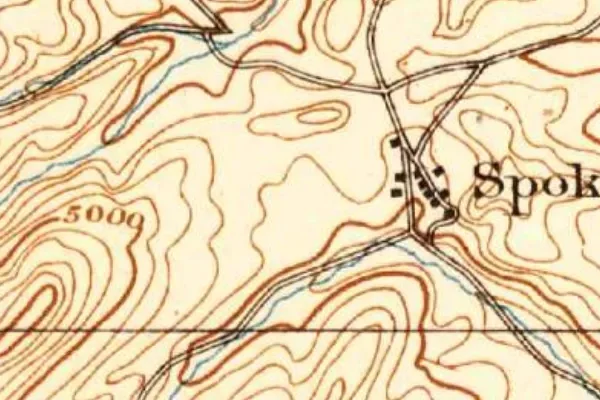
Spokane on the old USGS survey, and what the record holds around it
Within five miles the record maps 48 mine shafts, adits and prospect pits, 109 named mineral sites, 7 lost places and 2 cemeteries. Pro puts them on the map with the 1879–1919 survey underneath and a swipe to today.
Questions from the field
- Can you visit the Spokane ghost town in South Dakota?
- Yes — it sits on national forest land off the Iron Mountain Road east of Custer, one of the best-preserved ghost towns in the Black Hills. The old buildings are unsafe to enter, so view from outside.
From the field
The most valuable part of this record is the part only visitors can write.
Stamp your passport
Check in at Spokane — GPS-verified visits earn an inked stamp.
File a field report
Road conditions, what's still standing, what's gone — your report joins the record.
Add photographs
Credited, dated, and preserved as part of Spokane's permanent record.
No field reports yet — sign in to file the first.
Primary sources for this record
- — USGS GNIS feature 1262481
- — Wikipedia — Spokane, South Dakota
- — South Dakota Magazine — Spokane