The story
Mystic began in 1876 as a placer gold camp on Castle Creek in the central Black Hills, first called Sitting Bull after the Lakota leader, then renamed Mystic in 1889 for reasons no one recorded. The railroads made it more than a camp: the Burlington reached it in 1889, and in 1906 the Crouch Line arrived from Rapid City, making Mystic a junction and a hub for gold, timber, and the ambitious mills that tried to wring more metal from the district — including, in 1911, one of the first electric gold dredges in the Hills.
None of it lasted. Mystic's population fell away through the early twentieth century as the gold and the mills gave out. The Crouch Line was pulled up in 1947, the sawmill closed in 1952, and the post office followed in 1954, its business absorbed by nearby Rochford.
The old townsite, now on the National Register, sits along the Mickelson Trail — the rail-trail built on the abandoned grade — where hikers and cyclists pass a scatter of weathered buildings and foundations in a pretty stretch of the Black Hills.
What remains today
A handful of weathered buildings and foundations along Castle Creek, listed as the Mystic Townsite Historic District, beside the George S. Mickelson Trail.
Society Pro
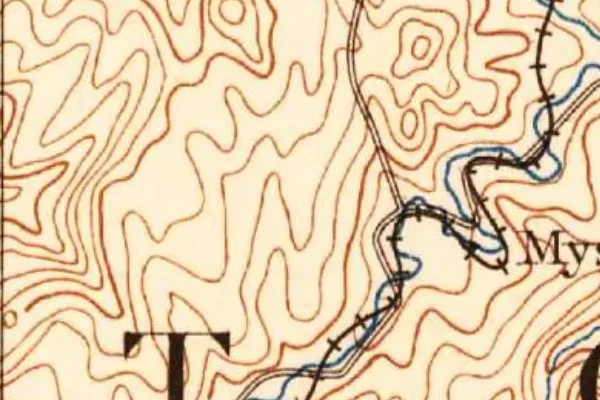
Mystic on the old USGS survey, and what the record holds around it
Within five miles the record maps 16 mine shafts, adits and prospect pits, 44 named mineral sites, 8 lost places and 0 cemeteries. Pro puts them on the map with the 1879–1919 survey underneath and a swipe to today.
Questions from the field
- What was Mystic, South Dakota's original name?
- Sitting Bull, for the Lakota leader — the 1876 placer gold camp was renamed Mystic in 1889. Its townsite is now a National Register historic district on the Mickelson Trail.
From the field
The most valuable part of this record is the part only visitors can write.
Stamp your passport
Check in at Mystic — GPS-verified visits earn an inked stamp.
File a field report
Road conditions, what's still standing, what's gone — your report joins the record.
Add photographs
Credited, dated, and preserved as part of Mystic's permanent record.
No field reports yet — sign in to file the first.
Primary sources for this record
- — USGS GNIS feature 1265300
- — Wikipedia — Mystic, South Dakota
- — National Register — Mystic Townsite Historic District