Field guide · causes
How Do Towns Become Ghost Towns? The Causes Explained
From mining busts to floods and fires — here's why thousands of American towns were abandoned.
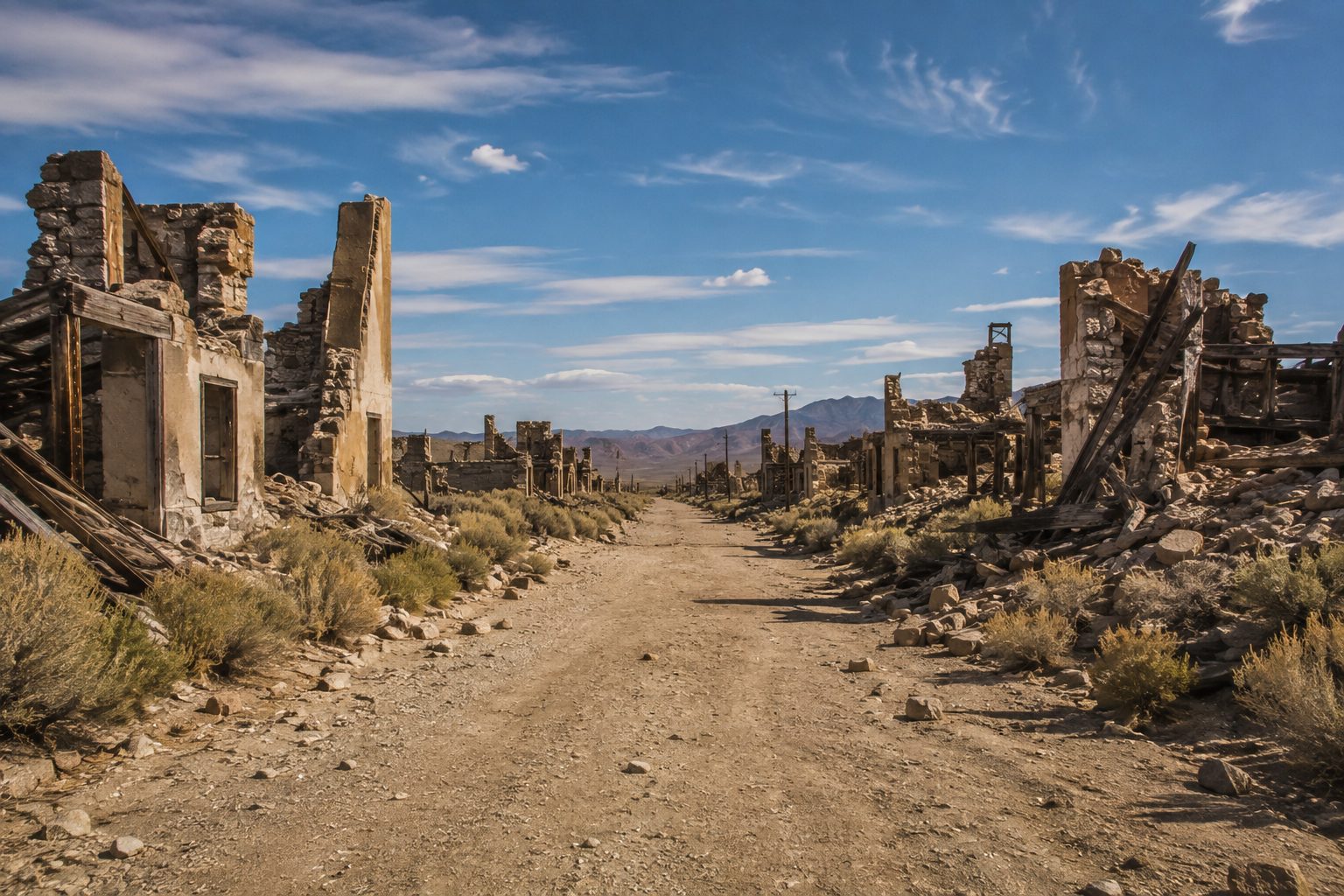
There's no single event that empties a town. No law says "abandon here." Instead, thousands of American towns died the same slow-then-sudden way: something they depended on completely — a mine, a railroad, a river, a fort — stopped being there, and there was nothing else holding the place together.
That's the short answer. The longer, more useful one is that why towns become ghost towns breaks down into a handful of repeatable causes, and knowing them changes how you read every abandoned townsite you visit. A collapsed headframe tells a different story than a flooded foundation. This page walks through the major causes one at a time, with real, verifiable examples you can go read the full story of. (If you haven't already, our guide to what actually defines a ghost town is a useful starting point before this one.)
It's rarely one thing — it's one point of failure
Almost every cause below traces back to the same structural weakness: the town had exactly one economic reason to exist, and no backup. A diversified city can absorb a closed factory. A 19th-century mining camp built around a single vein, or a rail town built around a single junction, had nothing to fall back on when that one thing ended. Remove it, and the population doesn't taper off over a generation — it can leave within a year or two.
That single-point-of-failure pattern shows up across every cause on this page, whether the trigger was economic, geographic, or entirely outside anyone's control. If you want the deeper economic breakdown of that pattern, our companion piece, How Towns Die: The Boom-Bust Economics of American Ghost Towns, goes further into the numbers. This page is about identifying which specific cause you're looking at.
Cause 1: The resource ran out
This is the single biggest cause of ghost towns in America, and it's almost always about mining. A strike — gold, silver, copper — pulls a population into a canyon or basin fast, sometimes within months. But ore bodies are finite. When the vein pinches out, when extraction costs exceed what the ore is worth, or when a price crash makes the whole operation unprofitable overnight, there's no reason left for anyone to stay.
Bodie, California is the textbook case. Gold was discovered there in 1859, but the real boom didn't hit until 1876; by 1879 the town held roughly 8,000 people and around 60 saloons. The rich ore didn't last — mining declined through the 1880s, and the town spent the next fifty years shrinking, not collapsing outright. Two fires, in 1892 and 1932, then destroyed much of what remained of the business district. Bodie is now California's best-preserved ghost town, kept in a deliberate state of "arrested decay." Read Bodie's full story →
Rhyolite, Nevada shows the faster version of the same collapse. Founded in 1904, it had electric lights, water mains, a stock exchange, and a three-story bank within three years — a population of roughly 5,000 at its 1907 peak. Then two things hit at once: the gold ore proved shallower than promised, and the nationwide Panic of 1907 cut off the eastern investment money the mines depended on. By 1916, Rhyolite was empty. Read Rhyolite's full story →
Cause 2: The transportation route moved
A huge number of towns existed purely to service transportation — water stops, coaling depots, rail junctions, stagecoach stations — rather than to extract anything from the ground. Their entire economy was other people passing through or the trains servicing that passage.
When railroads replaced steam locomotives with diesel, water stops and coaling depots became pointless overnight. When a new line was surveyed a few miles away, or a highway bypassed a town its economy depended on, the old route's businesses lost their customer base just as fast as any mining town lost its ore. You can see this pattern across the railroad ghost towns on this site — towns that had no independent reason to exist beyond the tracks running through them.
Cause 3: Water — too much, too little, or redirected
Water-related causes split into three distinct failure modes, and they're some of the most dramatic on this list because they're often deliberate.
Flooding by dam project is the most permanent. When a government project dams a river for power or water storage, everything upstream in the new reservoir's footprint has to go — sometimes with the residents watching their own streets disappear underwater for years as the reservoir fills.
St. Thomas, Nevada is one of the starkest examples of this on record. Founded in 1865 by Mormon farmers where the Muddy and Virgin Rivers meet, the town survived a bizarre 1871 tax revolt (residents burned their own homes rather than pay Nevada back taxes after a survey showed they weren't in Utah after all) — but it couldn't survive Hoover Dam. As Lake Mead rose through the 1930s, the government bought out the town, and residents watched the water climb their streets for years. The last resident, Hugh Lord, rowed away from his own house on June 11, 1938. Decades of drought have since dropped Lake Mead low enough to expose St. Thomas's foundations again. Read St. Thomas's full story →
Drought and irrigation failure work in the opposite direction — homestead colonies built around irrigation promises that never delivered enough water, or that dried up during multi-year droughts, simply couldn't keep farming families fed. And water diversion can strand a town just as effectively as a flood: rivers rerouted for other users leave a former port or mill town without the water that justified its location in the first place.
Cause 4: Fire, disease, and sudden disaster
Some towns didn't fade — they were hit. A fire that tears through a downtown built entirely of wood can erase a business district in an afternoon, and if the town's economy was already fragile, there's often no capital left to rebuild. Bodie's business district took exactly this kind of hit twice, in 1892 and 1932, compounding a decline that mining decline had already started.
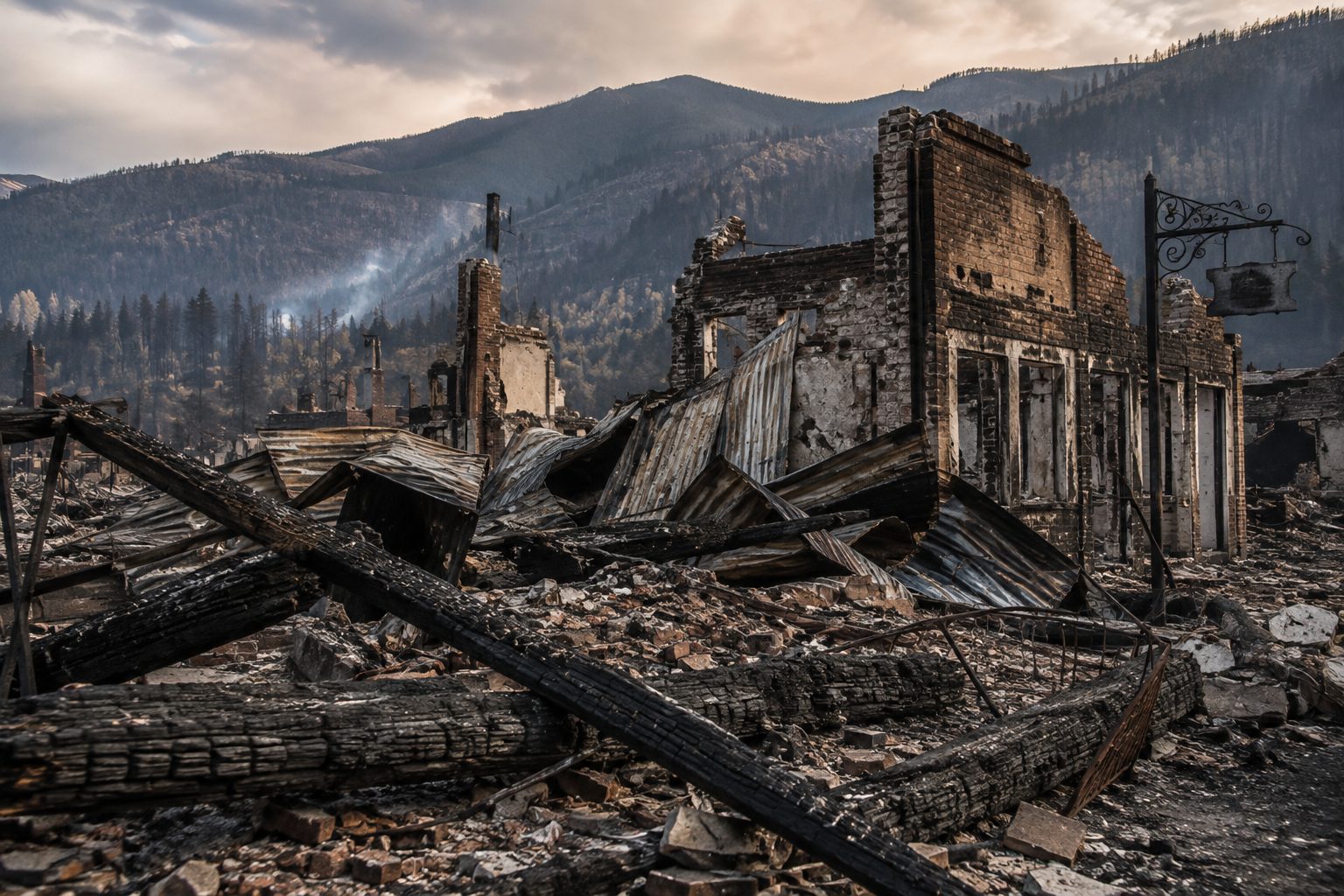
Epidemics did similar damage to smaller communities before modern medicine — a diphtheria or typhoid outbreak could kill or scatter a meaningful share of a town's population within a single season, especially in isolated mining or farming settlements without nearby medical care. Explosions (common in mining and munitions towns), landslides, and earthquakes round out this category: sudden, catastrophic, and often impossible to recover from economically even when the physical rebuilding was possible.
Cause 5: The government pulled out (or pulled the town in)
Not every cause is economic. Some towns existed because of government presence, and declined the moment that presence left.
County seats and territorial capitals are the clearest example. A town that served as the administrative center of a county drew a courthouse, government jobs, and the legal and business traffic that follows a courthouse. When a countywide vote — sometimes contentious, occasionally decided by residents literally hauling records to a new town overnight — moved the county seat elsewhere, the original town lost that anchor permanently. You can browse examples of this pattern among the lost capitals and county seats on this site.
Military base and fort closures worked similarly for towns that grew up entirely to service a nearby post — provisioning soldiers, running saloons and boarding houses, trading with the garrison. Once the military moved on, that entire customer base left with it.
Land seizure is the most abrupt version: the federal government has, at various points, cleared entire towns for military testing ranges, dam projects, or protected land, giving residents a deadline rather than a choice.
Cause 6: The slow fade — rural consolidation
Not every ghost town died suddenly. Many faded over decades as farming mechanized, family farms consolidated into larger operations needing far fewer workers, and rural populations drifted toward cities and larger regional towns with more services. No single event caused these towns to empty — just a slow draining, school closure by school closure and business closure by business closure, until what remained wasn't a functioning town anymore. This is the quietest cause on this list, but cumulatively one of the most common, especially across the Great Plains.
The common thread
Whatever the specific trigger, the underlying vulnerability is almost always the same: a town built around one industry, one route, or one institution has no cushion when that single thing disappears. That's why ghost towns cluster so heavily around mining districts, rail lines, and dam projects rather than being evenly spread across the map — those were the places where one point of failure could take out an entire local economy at once.
Frequently asked questions
- What's the single most common reason towns become ghost towns?
- Resource depletion — specifically mining. More American ghost towns trace back to a played-out mine or a mineral price crash than to any other single cause.
- Can a ghost town come back to life?
- Occasionally. Some historic mining towns reinvented themselves around tourism or gaming rather than disappearing completely — our definitional guide covers these "living ghost towns" in more detail. But a fully deserted townsite with no remaining population or infrastructure essentially never repopulates.
- Are ghost towns still being created today?
- Yes, though more slowly and for different reasons than the mining-boom era — mechanization, rural population decline, and occasionally disaster or contamination still empty small communities in the present day.
- Did every ghost town die for an economic reason?
- No. Water projects, military decisions, and natural disasters have emptied towns whose local economies were otherwise healthy — St. Thomas, Nevada is a clear example of a town killed by a dam project rather than economic failure.
Read their full stories
Every cause on this page has a real town behind it. Read Bodie's story, Rhyolite's story, or St. Thomas's story to see exactly how each of these causes played out on the ground — or browse the full map to find one near you.