Field guide · definitions
What Is a Ghost Town? Definition, Types, and How They Form
What actually makes a town a 'ghost town'? The definitions, the types, and the boom-bust history behind America's abandoned settlements.
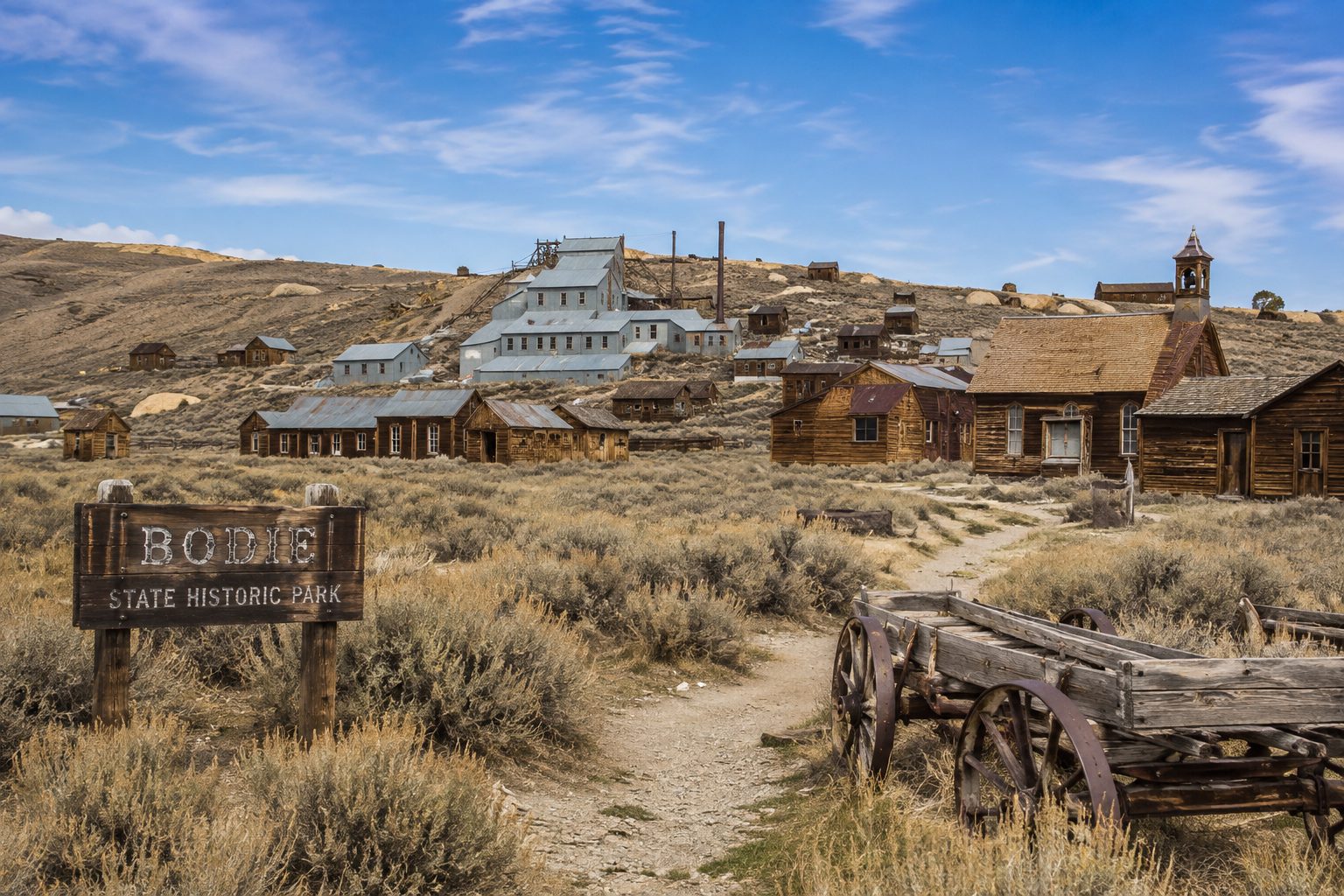
Every dictionary agrees on the easy part: a ghost town is a town that people left. What they can't agree on is where the line actually sits. Does one caretaker still living behind a boarded-up saloon disqualify a place? Does a mine that's still standing but roofless count more than one that's been bulldozed flat? Does a town that got flooded on purpose belong in the same category as one that just ran out of ore?
Those aren't trivia questions. They're the reason two people can stand in the same dusty townsite and argue about whether it's a "real" ghost town at all. This page settles the definition, walks through the main ways historians and researchers classify these places, and explains the handful of forces — economic, geographic, and sometimes just plain bad luck — that turn a living town into a memory. It's the starting point we link back to from every state and type page on this site, so bookmark it if you're new to the hobby.
So, what is a ghost town? A working definition
The most-cited definition comes from historian T. Lindsey Baker, who called a ghost town simply "a town for which the reason for being no longer exists." That's a sharper standard than it looks. It doesn't require an empty townsite — it requires an empty purpose. If the mine closed, the railroad rerouted, or the fort was decommissioned, the town has become a ghost town in Baker's sense even if a few families still live there, because the original reason anyone built it there in the first place is gone.
Author Lambert Florin put it more poetically, describing a ghost town as "a shadowy semblance of its former self" — a place still standing, technically, but hollowed out.
Between those two poles, researchers generally disagree on three specific points:
- 1.Does the cause matter? Some definitions only count towns killed by economic collapse (the mine closed, the crop failed). Others include towns wiped out by floods, fires, dam projects, or government seizure — even if the local economy was healthy the day before.
- 2.Do buildings have to be standing? A site reduced to foundations and a cemetery is a ghost town to most researchers, but some enthusiasts reserve the term for places with visible structures you can actually walk through.
- 3.Does population have to be zero? This is the biggest sticking point. A strict definition requires total desertion. A looser, more commonly used definition — and the one this site works from — accepts any settlement that has lost the overwhelming majority of its population and its original economic reason for existing, even if a handful of residents remain.
In practice, "ghost town" is used as an umbrella term covering everything from a scatter of foundations in the sagebrush to a town of 200 people surrounded by the ruins of the 20,000 who used to live there. That range is exactly why classification matters — and why the next section breaks it into working categories instead of one all-or-nothing label.
Ghost town vs. abandoned building: what's the difference?
Not every empty structure is a ghost town, and it's worth drawing that line clearly. An abandoned mall, a shuttered factory, or a single derelict farmhouse is an abandoned site — an isolated structure, often still surrounded by an otherwise functioning community. A ghost town is bigger than any one building: it's an entire settlement, with its own former streets, businesses, cemetery, and civic identity, that collectively lost its reason to exist. The distinguishing feature isn't decay, it's scale — you're looking at the remains of a community, not just a building.
The types of ghost towns, by degree of abandonment
The most useful way to sort ghost towns for visiting purposes is by how much is actually left — of both the town and its people. Researcher Philip Varney's framework, widely used across ghost-town literature, breaks that spectrum into three practical tiers.
True (or "dead") ghost towns are completely deserted. Nothing remains but foundations, scattered rubble, and maybe a cemetery — nature has largely reclaimed the site, and there's no one left to ask for directions. Loma Parda, New Mexico is a textbook example: once a rowdy off-post town that thrived on trade with soldiers from nearby Fort Union, it was fully deserted by World War II and today is little more than scattered stone walls.
Semi-ghost towns sit in the middle. The reason the town was founded — a mine, a rail junction, a mill — is gone, but a handful of residents remain, often in a fraction of the original buildings. Elkhorn, Montana fits here: two of its grand 19th-century buildings, Fraternity Hall and Gillian Hall, still stand as a state park along a nearly empty main street, with only about a dozen year-round residents left.
Living ghost towns (sometimes called "tourist ghost towns") are historic communities that are still functioning — with shops, residents, and a local economy — but at a small fraction of their boomtown-era size. Central City, Colorado is a classic example: a former Gold Rush boomtown that reinvented itself around tourism and gaming rather than disappearing entirely.
A fourth, informal category worth knowing is the restored or preserved ghost town — a site like Bodie, California, that's deserted of permanent residents but maintained (in Bodie's case, in a deliberate state of "arrested decay") as a state park or historic site specifically so visitors can walk through it.
The types of ghost towns, by cause
The degree-of-abandonment framework tells you what you'll find when you get there. This second framework — sorted by why the town died — tells you what to expect from its history, and it's how we organize every record on this site. Browse the full breakdown on our ghost town type index, or jump into one of the five main categories below.
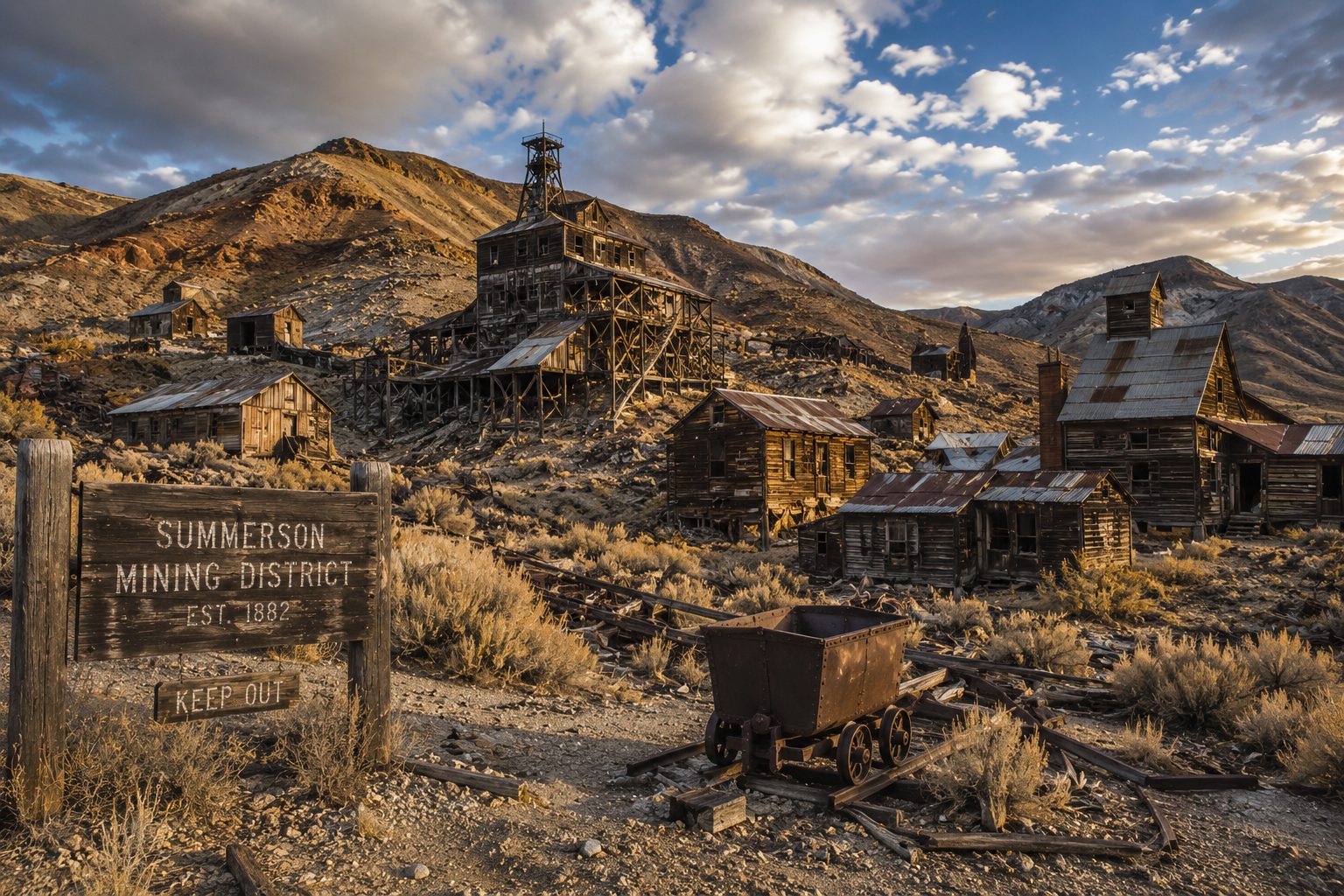
Mining ghost towns are the largest category by far, and for a simple reason: most of America's ghost towns died the same way — the ore ran out. A silver strike, a gold rush, or a copper boom would pull thousands of people into a canyon or a basin almost overnight, and when the vein pinched out or metal prices crashed, the town emptied just as fast. Bodie and Rhyolite are two of the best-documented examples of this pattern.
Railroad ghost towns grew up around water stops, junctions, coaling depots, and section camps that existed purely to service a rail line. When steam gave way to diesel, or when a new route bypassed the old line entirely, these towns lost their only reason for being almost overnight.
Farming and colony ghost towns cover the settlements undone by land and water rather than ore: flooded river towns, failed irrigation colonies, and homestead communities that drought or dust simply outlasted.
Company towns were owned outright by a single employer — a mining, timber, or manufacturing company that built the houses, ran the store, and controlled the utilities. When that company shut down or pulled out, there was no independent local economy left to keep the town alive.
Lost capitals and county seats declined for a very different reason: government, not geology. These towns' fortunes were tied to being the administrative center of a county or territory. When the county seat moved — often after a contentious local vote or even at gunpoint — the offices, the courthouse traffic, and the businesses that depended on them moved with it.
Many towns fit more than one category — a mining town that was also a company town, or a railroad stop that later served as a county seat — which is part of why the causes below matter more than the labels.
How ghost towns actually form: the boom-bust pattern
Almost every American ghost town, regardless of type, follows a version of the same arc: a single economic activity draws a population in fast, that activity becomes the entire local economy, and when it ends, there's nothing underneath the town to hold people there.
That's different from how most towns shrink. A city with a diversified economy can lose one employer and absorb the hit. A 19th-century mining camp or rail depot rarely had that cushion — it existed because of one mine, one line, or one company, full stop. Pull that one thing out and the population doesn't decline gradually over a generation; it can leave within a season. Bodie lost the majority of its population within a few years of its 1880s peak. Company towns have been known to empty within months of a plant closing.
The specific triggers vary — a played-out vein, a price crash, a rerouted highway, a dam project that floods the valley, a fire that never gets rebuilt from, a military base that gets decommissioned — but the underlying mechanism is almost always the same single-industry dependency. For a deeper dive into the five specific economic patterns behind most American ghost towns, see our companion piece, How Towns Die: The Boom-Bust Economics of American Ghost Towns.
How many ghost towns are there in the U.S.?
More than most people expect. Ghost Town Trails currently has over 52,000 surveyed sites logged across all 50 states, with detailed records completed for 210 of them so far — and the number climbs every year as researchers and local historians document more. States with heavy 19th-century mining and rail activity — California and Nevada chief among them — top the list by a wide margin, while smaller or later-settled states still have dozens each. You can browse the full count for any state on its dedicated state hub, or see everything at once on the interactive map.
Frequently asked questions
- Is a town with a few residents still a "ghost town"?
- Usually, yes — as long as its original reason for existing (the mine, the rail line, the fort) is gone and it has lost the overwhelming majority of its peak population. Researchers call these semi-ghost towns or living ghost towns rather than true (fully deserted) ghost towns.
- What's the difference between a ghost town and an abandoned building?
- Scale and identity. A ghost town is a former community — streets, businesses, a cemetery, a civic history — not a single structure. One derelict farmhouse next to an occupied town isn't a ghost town; it's just an abandoned building.
- What's the most common cause of ghost towns in America?
- Mining. Boom-and-bust mineral economies produced more American ghost towns than any other single cause, which is why mining ghost towns are the largest category on this site.
- Are ghost towns free and legal to visit?
- It depends entirely on the site — some are state parks with an entry fee, others sit on private land where entry requires permission, and some are on public land with open access. See our guide, Are Ghost Towns Legal to Visit? The Honest Answer, before you plan a trip.
Start exploring
Definitions and categories are useful, but the real value is in the towns themselves — where they were, what happened, and what's still standing. Explore the map to find every surveyed ghost town near you, or jump straight into a category above to start reading full town records.