The story
Valles Mines is older than the country it sits in. The French colonial official François Vallé opened lead mines here, in the eastern Ozarks south of present-day De Soto, around 1749 — a generation before the American Revolution — making it one of the earliest European mining settlements in the Mississippi Valley. Lead drew the first diggers; after the Civil War, zinc became the bigger prize, and the Valle Mining Company worked the ground into the early twentieth century, even winning a medal for its pig lead at the 1904 St. Louis World's Fair.
Like most of Missouri's old lead-and-zinc country, Valles Mines was a scattered community of shafts, smelters, and miners' homes rather than a tight town grid. When the workable ore ran out around 1920, the reason for the settlement went with it, and the community faded into the wooded hills.
It survives now as a quiet rural crossroads and ghost of a mining district: back roads, old workings, a cemetery, and scattered ruins among the trees, with a small local history effort keeping the long story alive.
What remains today
Old mine workings, a cemetery, and scattered ruins along the back roads of a former lead-and-zinc district; no intact town center.
Society Pro
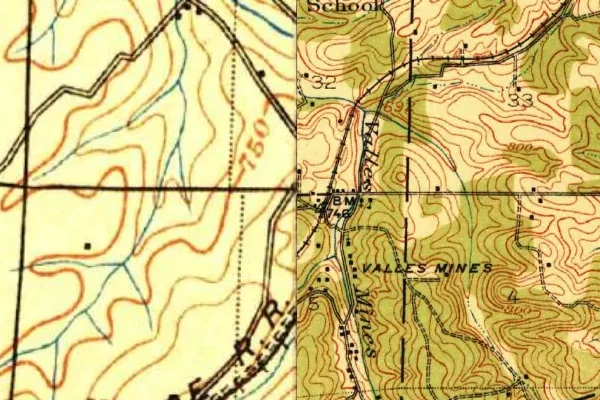
Valles Mines on the old USGS survey, and what the record holds around it
Within five miles the record maps 9 mine shafts, adits and prospect pits, 90 named mineral sites, 10 lost places and 12 cemeteries. Pro puts them on the map with the 1879–1919 survey underneath and a swipe to today.
From the archives
Valles Mines turns up on 6,463 digitized newspaper pages from Missouri — read them free in the Library of Congress's Chronicling America collection.
Source: Library of Congress digital collections.
Questions from the field
- How old is Valles Mines, Missouri?
- Its lead mines were opened by François Vallé around 1749, decades before American independence, making it one of the oldest mining settlements in the Mississippi Valley.
From the field
The most valuable part of this record is the part only visitors can write.
Stamp your passport
Check in at Valles Mines — GPS-verified visits earn an inked stamp.
File a field report
Road conditions, what's still standing, what's gone — your report joins the record.
Add photographs
Credited, dated, and preserved as part of Valles Mines's permanent record.
No field reports yet — sign in to file the first.
Primary sources for this record
- — USGS GNIS feature 736358
- — Wikipedia — Valles Mines, Missouri
- — USGS — Southeast Missouri Barite District and the Valles Mines