The story
Times Beach began as a newspaper promotion — riverfront lots sold with subscriptions — and grew into a modest working-class town on Route 66. In the 1970s a waste hauler sprayed its dusty roads with oil laced with dioxin; in December 1982 the Meramec flooded the town just as tests confirmed the contamination, and the CDC advised residents never to return.
The 1983 federal buyout — the EPA's first whole-town relocation — moved more than 2,000 people; the buildings were demolished and the soil incinerated on-site in the 1990s. The ground reopened in 1999 as Route 66 State Park, whose visitor center (the old roadhouse, which survived it all) tells the dioxin story straight.
What remains today
Nothing of the town but road traces inside Route 66 State Park; the 1935 Steiny's roadhouse serves as visitor center and museum.
Society Pro
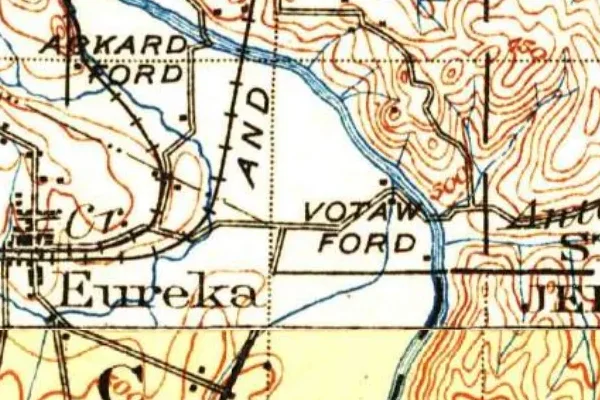
Times Beach on the old USGS survey, and what the record holds around it
Within five miles the record maps 16 mine shafts, adits and prospect pits, 22 named mineral sites, 4 lost places and 4 cemeteries. Pro puts them on the map with the 1879–1919 survey underneath and a swipe to today.
From the archives
Times Beach turns up on 135,734 digitized newspaper pages from Missouri — read them free in the Library of Congress's Chronicling America collection.
Source: Library of Congress digital collections.
Questions from the field
- Is Times Beach safe now?
- Yes — after soil incineration and EPA delisting, the site is a public state park. The contamination chapter is finished; the park interprets it rather than burying it.
From the field
The most valuable part of this record is the part only visitors can write.
Stamp your passport
Check in at Times Beach — GPS-verified visits earn an inked stamp.
File a field report
Road conditions, what's still standing, what's gone — your report joins the record.
Add photographs
Credited, dated, and preserved as part of Times Beach's permanent record.
No field reports yet — sign in to file the first.
Primary sources for this record
- — USGS GNIS feature 758452
- — EPA — Times Beach Superfund records
- — Missouri State Parks — Route 66 State Park