The story
Shasta was the hub of California's northern gold rush — 'Queen City of the North' — where every stage and mule train to the Trinity mines paused. Its brick business row, built after fires leveled the wooden town twice, was the proudest in the region in the 1850s.
The Central Pacific put its tracks — and the future — six miles east at Redding in 1872, and Shasta bled businesses until the county seat itself left in 1888. The roofless brick arcade that remains is one of the most evocative gold-rush ruins in the state, preserved as Shasta State Historic Park.
What remains today
The half-mile row of brick ruins, the restored 1861 courthouse (museum, with gallows), and the Litsch general store, all state-managed.
Society Pro
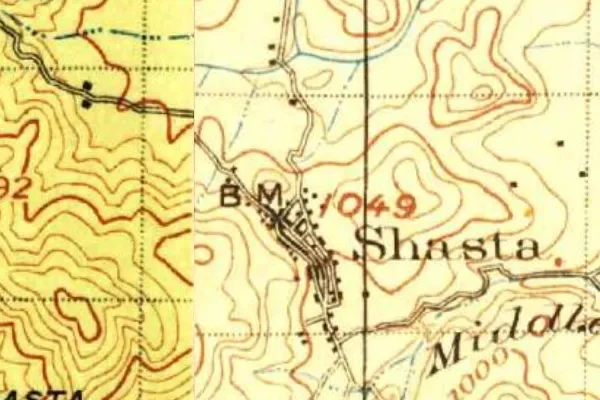
Shasta on the old USGS survey, and what the record holds around it
Within five miles the record maps 48 mine shafts, adits and prospect pits, 237 named mineral sites, 6 lost places and 5 cemeteries. Pro puts them on the map with the 1879–1919 survey underneath and a swipe to today.
From the archives

Shasta County, California. Mount Shasta

Shasta Dam, Shasta County, California. Workman

Shasta Dam, Shasta County, California. Workman

Shasta Dam, Shasta County, California. Sign
Source: Library of Congress digital collections.
Questions from the field
- Is Shasta ghost town the same as Mount Shasta?
- No — Shasta State Historic Park is a gold-rush ruin outside Redding, an hour south of the volcano and the town of Mount Shasta.
From the field
The most valuable part of this record is the part only visitors can write.
Stamp your passport
Check in at Shasta — GPS-verified visits earn an inked stamp.
File a field report
Road conditions, what's still standing, what's gone — your report joins the record.
Add photographs
Credited, dated, and preserved as part of Shasta's permanent record.
No field reports yet — sign in to file the first.
Primary sources for this record
- — USGS GNIS feature 232871
- — California State Parks — Shasta SHP
- — Shasta County Historical Society