The story
Masonic sits high in the Bodie Hills near the Nevada line, named for the Freemasons who prospected the area in the 1860s. Its early claims were overshadowed by the huge strikes at nearby Bodie and Aurora, and the district slept for decades. The turn came on July 4, 1902, when three partners struck a rich quartz ledge and founded the Pittsburg-Liberty Mine, with ore assaying anywhere from $35 to $800 a ton. By 1906 Masonic had around 1,000 people spread through its Upper, Middle, and Lower towns.
The veins were rich but erratic, and production slid after 1911. The post office opened and closed and finally shut for good in 1927, and the population fell to about a dozen by 1920. The wartime ban on non-essential gold mining in World War II ended any last hope, leaving Masonic to the sagebrush and the wind.
What remains today
The Pittsburg-Liberty mine and mill ruins, collapsing cabins, and scattered workings across the Upper, Middle, and Lower townsites in the Bodie Hills.
Society Pro
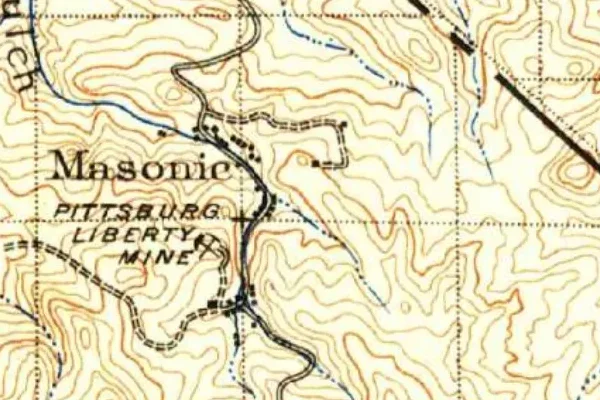
Masonic on the old USGS survey, and what the record holds around it
Within five miles the record maps 269 mine shafts, adits and prospect pits, 47 named mineral sites, 2 lost places and 0 cemeteries. Pro puts them on the map with the 1879–1919 survey underneath and a swipe to today.
From the archives
![[Masonic Hall, Bodie, California]](https://tile.loc.gov/storage-services/service/pnp/cph/3c10000/3c14000/3c14300/3c14312_150px.jpg#h=120&w=150)
[Masonic Hall, Bodie, California]

Masonic Hall, Petaluma Boulevard & Western Avenue, Petaluma, California

Masonic Temple, angle view, Mineral King Avenue, Visalia, California

Masonic Temple (1920), door detail, Lassen Street, Susanville, California
Source: Library of Congress digital collections.
Questions from the field
- How is Masonic different from Bodie?
- Bodie is a preserved state park with over a hundred buildings and daily visitors; Masonic is a genuinely remote, unmanaged ruin reached by a rough dirt road, with collapsing structures and no facilities. It's for those who want the real backcountry version.
From the field
The most valuable part of this record is the part only visitors can write.
Stamp your passport
Check in at Masonic — GPS-verified visits earn an inked stamp.
File a field report
Road conditions, what's still standing, what's gone — your report joins the record.
Add photographs
Credited, dated, and preserved as part of Masonic's permanent record.
No field reports yet — sign in to file the first.
Primary sources for this record
- — Wikipedia — Masonic, California
- — Western Mining History — Masonic, California
- — HistoryNet — 'Ghost Towns: Masonic, California'