The story
Chinese Camp was one of the largest Chinese communities of the Gold Rush — as many as 5,000 miners worked its placers in the 1850s, pushed here from other camps by discriminatory taxes and violence, and building their own stores, temples, and stage lines.
In 1856 it hosted the famous tong war between rival associations — hundreds of combatants with forged pikes and a handful of firearms, ending with four dead and the leaders jailed. The placers thinned, and the community dispersed over the decades; a few dozen residents live around the old store and the ruins today, straddling Highway 120's Yosemite traffic.
What remains today
The 1854 stone post office/store, St. Francis Xavier church (1855), stone ruins, and 'trees of heaven' the miners planted.
Society Pro
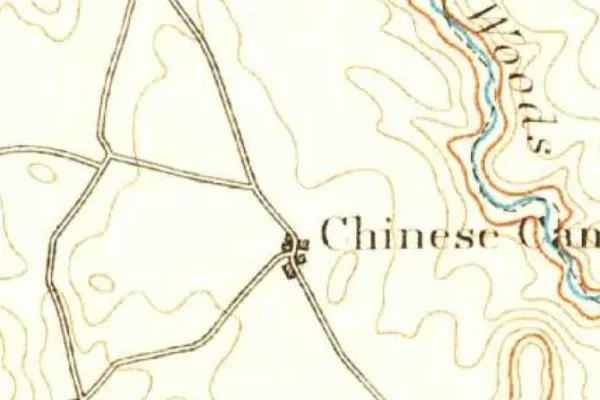
Chinese Camp on the old USGS survey, and what the record holds around it
Within five miles the record maps 189 mine shafts, adits and prospect pits, 210 named mineral sites, 1 lost places and 4 cemeteries. Pro puts them on the map with the 1879–1919 survey underneath and a swipe to today.
From the archives
Chinese Camp turns up on 395,192 digitized newspaper pages from California — read them free in the Library of Congress's Chronicling America collection.
Source: Library of Congress digital collections.
Questions from the field
- Why is it called Chinese Camp?
- Because by the mid-1850s it was the Gold Rush's largest predominantly Chinese mining town — a rare place where displaced Chinese miners built a full community of their own.
From the field
The most valuable part of this record is the part only visitors can write.
Stamp your passport
Check in at Chinese Camp — GPS-verified visits earn an inked stamp.
File a field report
Road conditions, what's still standing, what's gone — your report joins the record.
Add photographs
Credited, dated, and preserved as part of Chinese Camp's permanent record.
No field reports yet — sign in to file the first.
Primary sources for this record
- — USGS GNIS feature 233668
- — Tuolumne County Historical Society
- — California Historical Landmark #423 records