The story
Nighthawk sits on the Similkameen River right against the Canadian border, in one of Washington's oldest mining districts — prospecting here dates to the 1860s, when the region was still a territory. The town was formally platted in 1903 and quickly became a small boomtown, with a hotel, a railroad depot, and a string of mills processing ore from mines like the Nighthawk, Ruby Silver, and Kaaba-Texas.
At its height the district ran several concentration mills, but the ore bodies were modest and the mines closed one after another. The last, the Kaaba-Texas, worked from 1915 until 1951, and after it shut the town had little reason to continue.
Nighthawk is a quiet survivor. J.M. Hagerty's 1903 hotel (rebuilt after a 1910 fire), the original schoolhouse, a mining office, and an old mill still stand, watched over by a population of about five. It is a genuine, lightly-visited border ghost town rather than a museum.
What remains today
The 1903 Hagerty hotel, the original schoolhouse, a mining office, and an old mill — real, weathered buildings near the border.
Society Pro
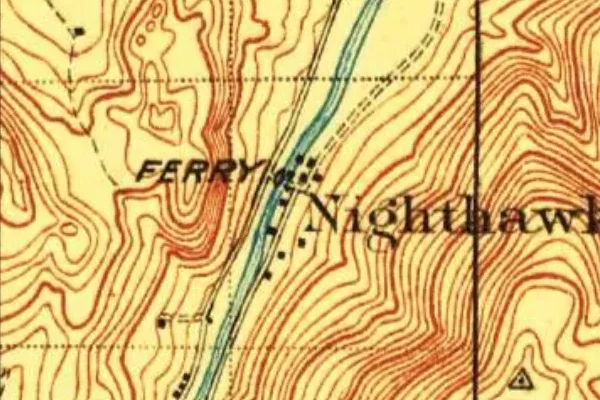
Nighthawk on the old USGS survey, and what the record holds around it
Within five miles the record maps 93 mine shafts, adits and prospect pits, 121 named mineral sites, 0 lost places and 0 cemeteries. Pro puts them on the map with the 1879–1919 survey underneath and a swipe to today.
From the archives
Nighthawk turns up on 5,557 digitized newspaper pages from Washington — read them free in the Library of Congress's Chronicling America collection.
Source: Library of Congress digital collections.
Questions from the field
- Are there still buildings standing in Nighthawk, Washington?
- Yes — the 1903 hotel, the old schoolhouse, a mining office, and a mill survive, along with about five residents. It is one of the more intact small ghost towns in the Okanogan.
From the field
The most valuable part of this record is the part only visitors can write.
Stamp your passport
Check in at Nighthawk — GPS-verified visits earn an inked stamp.
File a field report
Road conditions, what's still standing, what's gone — your report joins the record.
Add photographs
Credited, dated, and preserved as part of Nighthawk's permanent record.
No field reports yet — sign in to file the first.
Primary sources for this record
- — USGS GNIS feature 1523657
- — Okanogan County Historical Society
- — Washington State — Nighthawk mining district records