The story
Mortimer was built in 1904 when the Ritter Lumber Company bought the land along Wilson Creek to house its mill workers. At its peak roughly 800 people lived there, with a company store, a hotel, a school, a church, a movie theater, and a blacksmith — a busy mill town deep in what is now the Pisgah National Forest.
Wilson Creek undid it in two blows. In 1916 a fire on the ridges was followed by a catastrophic flood — the worst in Caldwell County's history — that wrecked the logging railroad and the dam and drove the lumber company out within a year. A cotton mill revived the town in the 1920s, and a Civilian Conservation Corps camp repaired much of the damage in the 1930s. Then in August 1940 a coastal hurricane pushed Wilson Creek over its banks again, and this second flood, only twenty-four years after the first, finally emptied the valley.
Today Mortimer is a quiet cluster of ruins and foundations along the creek — the shell of the old company store, remnants of the hotel and boarding houses, and CCC-era structures — beside a Forest Service campground popular with anglers and paddlers.
What remains today
The company-store ruin, hotel and boarding-house foundations, and CCC-era structures along Wilson Creek, near the Mortimer Recreation Area.
Society Pro
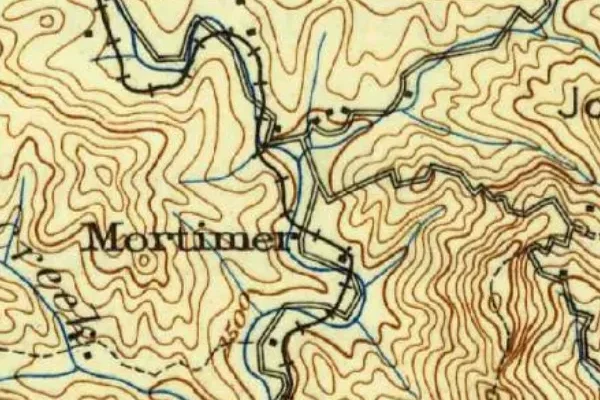
Mortimer on the old USGS survey, and what the record holds around it
Within five miles the record maps 1 mine shafts, adits and prospect pits, 10 named mineral sites, 0 lost places and 3 cemeteries. Pro puts them on the map with the 1879–1919 survey underneath and a swipe to today.
Questions from the field
- What destroyed Mortimer, North Carolina?
- Two floods on Wilson Creek. A fire and flood in 1916 drove out the original lumber company, and a hurricane-driven flood in 1940 finished the town off for good.
From the field
The most valuable part of this record is the part only visitors can write.
Stamp your passport
Check in at Mortimer — GPS-verified visits earn an inked stamp.
File a field report
Road conditions, what's still standing, what's gone — your report joins the record.
Add photographs
Credited, dated, and preserved as part of Mortimer's permanent record.
No field reports yet — sign in to file the first.
Primary sources for this record
- — USGS GNIS feature 1021538
- — U.S. Forest Service — Pisgah National Forest, Wilson Creek
- — Caldwell County historical records