The story
The hills around Golden hosted what is often called the first gold rush west of the Mississippi. Placer gold was found on Tuerto Creek in the 1820s, and two small camps — El Real de San Francisco and Placer del Tuerto — grew before California or Colorado had heard the word gold. The town of Golden formed later on the southwest side of the Ortiz Mountains and absorbed the older camps.
The placers were never rich enough to build anything permanent. Golden peaked around the turn of the century — some accounts claim as many as 3,000 people, though that figure is boomtown memory more than record — and dwindled steadily afterward. When the post office closed in 1928 the town was, officially, a ghost.
The 2020 census counted 19 residents. The town's landmark is the San Francisco Catholic Church, an adobe mission restored in 1960 and one of the most photographed stops on the Turquoise Trail between Cerrillos and Madrid.
What remains today
The restored adobe San Francisco church above the highway, old store buildings, scattered houses, and the placer diggings in the surrounding hills.
Society Pro
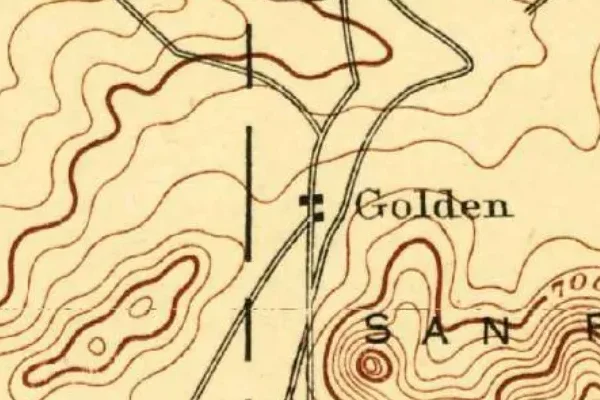
Golden on the old USGS survey, and what the record holds around it
Within five miles the record maps 171 mine shafts, adits and prospect pits, 34 named mineral sites, 3 lost places and 2 cemeteries. Pro puts them on the map with the 1879–1919 survey underneath and a swipe to today.
From the archives

Golden Rule and New York Stores, South 1st Street, Raton, New Mexico

Indian court, Federal Building, Golden Gate International Exposition, San Francisco, 1939 Antelope hunt from a

Indian court, Federal Building, Golden Gate International Exposition, San Francisco, 1939 Pueblo turtle dancer

The Golden Desert Motel on historic U.S. Route 66 in Gallup, a small city near the Arizona border in far-weste
Source: Library of Congress digital collections.
Questions from the field
- Was Golden really the first gold rush in the West?
- The placer diggings near Golden, worked from the 1820s, are commonly cited as the first significant gold rush west of the Mississippi River — years before the California strike of 1848.
From the field
The most valuable part of this record is the part only visitors can write.
Stamp your passport
Check in at Golden — GPS-verified visits earn an inked stamp.
File a field report
Road conditions, what's still standing, what's gone — your report joins the record.
Add photographs
Credited, dated, and preserved as part of Golden's permanent record.
No field reports yet — sign in to file the first.
Primary sources for this record
- — USGS GNIS feature 915830
- — New Mexico Tourism — Golden ghost town
- — Intermountain Histories — Golden, New Mexico