The story
Garnet boomed late — 1895, when new milling made its gold pay — and by 1898 about a thousand people filled a town notable for its families: unlike most camps, Garnet's miners brought wives and children, built a school, and skipped the worst of the gunfire. Fire took half the business district in 1912, and the ore was fading anyway; a Depression-era revival ended for good with the wartime mine closures.
Because it emptied fast and sits high and remote, Garnet kept its buildings: the BLM now preserves about thirty, including the three-story J.K. Wells Hotel, cabins with furnishings, and saloons. In winter it's reachable only over snow — rentable cabins make it one of America's few ghost towns you can legally overnight in.
What remains today
~30 original structures — hotel, saloons, store, cabins — with interpretation, in BLM care above Bear Gulch.
Society Pro
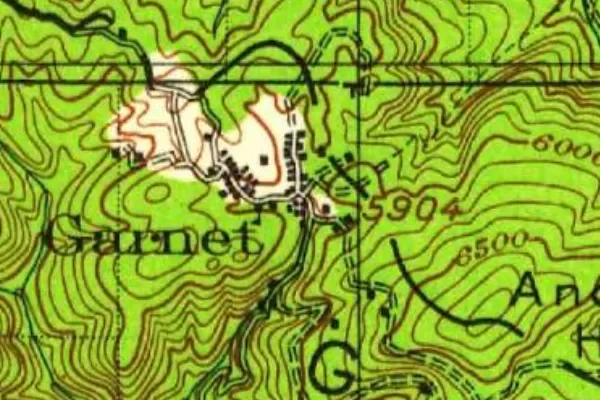
Garnet on the old USGS survey, and what the record holds around it
Within five miles the record maps 83 mine shafts, adits and prospect pits, 127 named mineral sites, 9 lost places and 1 cemeteries. Pro puts them on the map with the 1879–1919 survey underneath and a swipe to today.
From the archives

Cows graze in a field near the community of Potomac, east of Missoula, Montana, in a Garnet Mountain valley

Cows graze in a field near the community of Potomac, east of Missoula, Montana, in a Garnet Mountain valley

Overview of the 1890s Garnet Ghost Town, named for the ruby-colored stone found nearby, which is the most inta

Scene at the 1890s Garnet Ghost Town, named for the ruby-colored stone found nearby, which is the most intact
Source: Library of Congress digital collections.
Questions from the field
- Can you stay overnight in Garnet?
- Yes — the BLM rents two rustic cabins in winter, when the town is snowed in and reachable only by ski or snowmobile. Summer is day-use.
From the field
The most valuable part of this record is the part only visitors can write.
Stamp your passport
Check in at Garnet — GPS-verified visits earn an inked stamp.
File a field report
Road conditions, what's still standing, what's gone — your report joins the record.
Add photographs
Credited, dated, and preserved as part of Garnet's permanent record.
No field reports yet — sign in to file the first.
Primary sources for this record
- — USGS GNIS feature 771716
- — BLM — Garnet Ghost Town
- — Garnet Preservation Association