The story
Cochran was a small mining and railroad camp on the Gila River, settled in 1905 and named for its first postmaster, John Cochran. It served as a stop on the railroad now known as the Copper Basin line and supported perhaps a hundred people, with a store and a boarding house.
Its lasting monuments stand across the river: a row of five beehive-shaped stone coke ovens, each roughly 25 feet across and 30 feet tall. Built to slow-burn mesquite into coke for smelting gold and silver ore, they outlasted the town by more than a century. The post office closed in 1915 and Cochran itself dissolved back into the desert.
What remains today
The five stone beehive coke ovens on the far bank of the Gila; the townsite proper is gone to foundations and scatter.
Society Pro
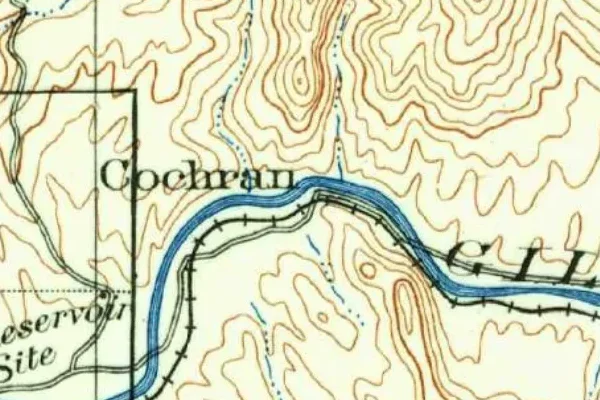
Cochran on the old USGS survey, and what the record holds around it
Within five miles the record maps 133 mine shafts, adits and prospect pits, 17 named mineral sites, 0 lost places and 0 cemeteries. Pro puts them on the map with the 1879–1919 survey underneath and a swipe to today.
Questions from the field
- What are the coke ovens at Cochran?
- Five beehive-shaped stone ovens built to bake mesquite wood into coke, a hotter fuel for smelting ore. They stand across the Gila River from the vanished townsite and are the main reason people still seek Cochran out.
From the field
The most valuable part of this record is the part only visitors can write.
Stamp your passport
Check in at Cochran — GPS-verified visits earn an inked stamp.
File a field report
Road conditions, what's still standing, what's gone — your report joins the record.
Add photographs
Credited, dated, and preserved as part of Cochran's permanent record.
No field reports yet — sign in to file the first.
Primary sources for this record
- — USGS GNIS feature 24373
- — Wikipedia — Cochran, Arizona
- — Butte-Cochran charcoal ovens (National Register of Historic Places)