The story
Jerome was copper royalty: the United Verde and Little Daisy mines made it Arizona's fourth-largest city in the 1920s, fifteen thousand people stacked on the side of Cleopatra Hill so steeply that dynamite blasts kept sliding the jail downhill. It burned repeatedly, subsided constantly, and earned a national reputation as 'the wickedest town in the West.'
Phelps Dodge closed the mine in 1953 and Jerome collapsed to fifty-odd holdouts who, in a stroke of genius, marketed their home as a ghost town while hippies and artists trickled in through the 60s and 70s to claim the empty houses.
Today about 450 people run its galleries, saloons, and haunted hotels for a million-plus annual visitors — the definitive proof that 'ghost town' can be a second act rather than an ending.
What remains today
Substantially intact hillside town: the Douglas Mansion (Jerome State Historic Park), Grand Hotel, sliding jail, mine headframes, and museum.
Society Pro
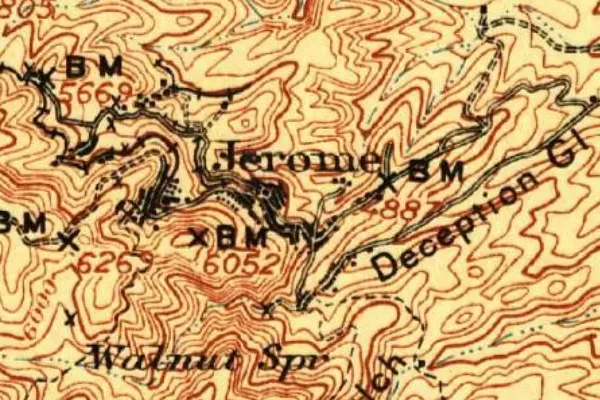
Jerome on the old USGS survey, and what the record holds around it
Within five miles the record maps 157 mine shafts, adits and prospect pits, 80 named mineral sites, 0 lost places and 1 cemeteries. Pro puts them on the map with the 1879–1919 survey underneath and a swipe to today.
From the archives

Jerome, Arizona

Scenery, Jerome, Arizona

Dixcel Gas sign, Jerome, Arizona

Visible gas pump, detail, Jerome, Arizona
Source: Library of Congress digital collections.
Questions from the field
- Is Jerome a real ghost town?
- It was — from 15,000 people to about 50 after the 1953 mine closure. Its revival as an arts-and-tourism town of ~450 makes it the country's best-known 'living ghost town.'
- What is there to do in Jerome?
- Jerome State Historic Park's mining museum, the Gold King Mine yard, galleries and saloons on the switchback streets, and the famous view a mile above the Verde Valley.
From the field
The most valuable part of this record is the part only visitors can write.
Stamp your passport
Check in at Jerome — GPS-verified visits earn an inked stamp.
File a field report
Road conditions, what's still standing, what's gone — your report joins the record.
Add photographs
Credited, dated, and preserved as part of Jerome's permanent record.
No field reports yet — sign in to file the first.
Primary sources for this record
- — USGS GNIS feature 30522
- — Jerome State Historic Park / Jerome Historical Society
- — United Verde mine production records