The story
Thurber was the largest company town Texas ever built. The Texas and Pacific Coal Company took over the mines in 1888 and fenced its property to build a complete town inside: schools, churches, saloons, stores, an opera house seating over 650, a 200-room hotel, an electric plant, and the only library in the county. At its height around 1918–20 as many as 8,000 to 10,000 people lived here — Italians, Poles, Britons, Irish, Mexicans, and a dozen other nationalities recruited to dig coal and make paving brick.
It was also a landmark of American labor: the United Mine Workers organized Thurber in 1903, making it one of the first fully unionized towns in the country. The end came from oil. The company struck the Ranger field nearby in 1917, renamed itself Texas Pacific Coal and Oil, and as railroads converted from coal to oil-burning locomotives the demand for Thurber's coal collapsed. Wage cuts, strikes in the mid-1920s, and closures hollowed the town, and by the late 1930s it was a ghost.
What remains today
The 128-foot smokestack landmark, the cemetery, the W.K. Gordon Center for Industrial History of Texas, and a few buildings including the New York Hill and Smokestack restaurants.
Society Pro
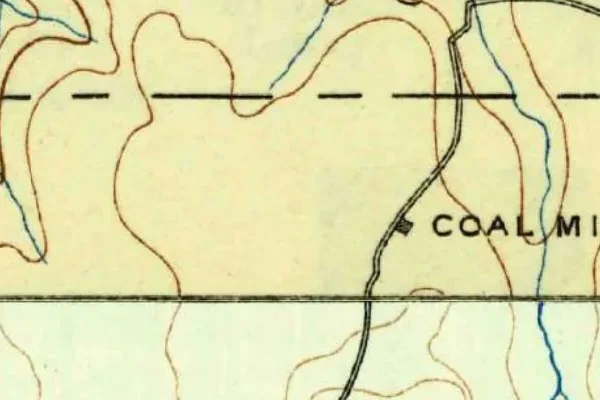
Thurber on the old USGS survey, and what the record holds around it
Within five miles the record maps 13 mine shafts, adits and prospect pits, 4 named mineral sites, 0 lost places and 6 cemeteries. Pro puts them on the map with the 1879–1919 survey underneath and a swipe to today.
From the archives
Thurber turns up on 57,135 digitized newspaper pages from Texas — read them free in the Library of Congress's Chronicling America collection.
Source: Library of Congress digital collections.
Questions from the field
- How big was Thurber, Texas?
- At its peak around 1918–20 it held roughly 8,000 to 10,000 people, making it the principal bituminous-coal town in Texas and one of the largest company towns in the country — all of it owned by the coal company.
- What is there to see in Thurber today?
- The W.K. Gordon Center for Industrial History of Texas, the town's 128-foot brick smokestack, the cemetery, and the Smokestack and New York Hill restaurants built into surviving structures just off I-20.
From the field
The most valuable part of this record is the part only visitors can write.
Stamp your passport
Check in at Thurber — GPS-verified visits earn an inked stamp.
File a field report
Road conditions, what's still standing, what's gone — your report joins the record.
Add photographs
Credited, dated, and preserved as part of Thurber's permanent record.
No field reports yet — sign in to file the first.
Primary sources for this record
- — USGS GNIS feature 1379160
- — Texas State Historical Association — Handbook of Texas, 'Thurber, TX'
- — W.K. Gordon Center for Industrial History of Texas (Tarleton State University)