The story
Concrete City was a experiment in company housing: twenty concrete double houses arranged around a central courtyard with tennis courts and a ball field, built in 1911 by the coal division of the Delaware, Lackawanna & Western Railroad for select workers at its Truesdale Colliery. Each unit had two stories, several bedrooms, and a concrete outhouse — solid, fireproof, and modern for its miners, most of them Eastern European immigrants.
The whole project lasted barely a decade. In 1924 the local township demanded a proper sewage system, and the roughly $200,000 cost was judged not worth it; the company simply abandoned the village. Later owner Glen Alden Coal tried to demolish the houses and gave up after some hundred sticks of dynamite failed to bring even one of them down.
So the shells still stand in the woods at the edge of Nanticoke — roofless, doorless, elaborately graffitied concrete boxes around an overgrown courtyard. The land belongs to the city, which has used it for fire and police training, and the ruins draw urban explorers and paintball players. There are no signs, no railings, and no maintenance; the structures are genuinely unstable.
What remains today
Around twenty roofless concrete double-house shells and the outline of the central courtyard, heavily graffitied, in woods on the southeast edge of Nanticoke.
Society Pro
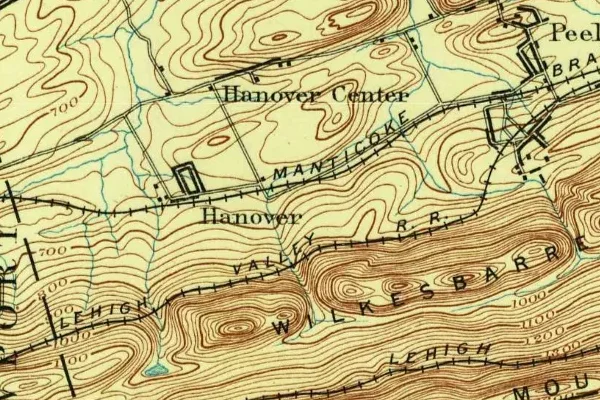
Concrete City on the old USGS survey, and what the record holds around it
Within five miles the record maps 48 mine shafts, adits and prospect pits, 1 named mineral sites, 0 lost places and 38 cemeteries. Pro puts them on the map with the 1879–1919 survey underneath and a swipe to today.
From the archives

An abandoned building in Concrete City, near Nanticoke, Pennsylvania, an early example of International Style

An abandoned building in Concrete City, near Nanticoke, Pennsylvania, an early example of International Style

An abandoned building in Concrete City, near Nanticoke, Pennsylvania, an early example of International Style

An abandoned building in Concrete City, near Nanticoke, Pennsylvania, an early example of International Style
Concrete City turns up on 303,557 digitized newspaper pages from Pennsylvania — read them free in the Library of Congress's Chronicling America collection.
Source: Library of Congress digital collections.
Questions from the field
- Why couldn't Concrete City be torn down?
- The houses were built entirely of poured concrete. Glen Alden Coal reportedly tried to demolish them with about a hundred sticks of dynamite and abandoned the effort after failing to destroy a single unit.
From the field
The most valuable part of this record is the part only visitors can write.
Stamp your passport
Check in at Concrete City — GPS-verified visits earn an inked stamp.
File a field report
Road conditions, what's still standing, what's gone — your report joins the record.
Add photographs
Credited, dated, and preserved as part of Concrete City's permanent record.
No field reports yet — sign in to file the first.
Primary sources for this record
- — Explore PA History — Concrete City historical marker
- — Luzerne County historical records
- — National Register of Historic Places — Truesdale Colliery context