The story
Granite grew out of a gold strike in the Blue Mountains on July 4, 1862 — the settlers first called it Independence for the date, then chose Granite when they found the name already taken. By 1900 it had hotels, stores, saloons, a drug store, and a livery serving the surrounding mines and, later, dredging along the creeks.
The town's peak population is hard to pin down: local lore throws around figures in the thousands, but the mining district was larger than the town itself, and the settlement was more likely a few hundred people at its best. Either way, the decline was steep. When the federal government halted gold mining as nonessential during World War II in 1942, the last props were knocked out, and by 1960 only two people were left.
Granite is still incorporated — one of Oregon's smallest cities, with fewer than 40 residents — and a handful of old buildings survive among newer cabins. It is a living near-ghost at the end of the mountain road, honest about how close it came to disappearing entirely.
What remains today
A few original buildings — an old store, the drug store, and cabins — among modern homes, plus dredge tailings along the nearby creeks.
Society Pro
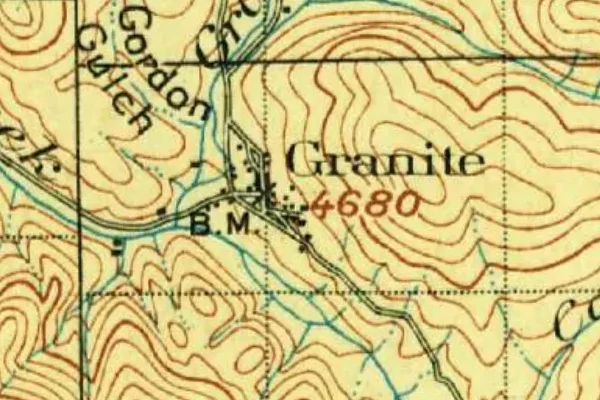
Granite on the old USGS survey, and what the record holds around it
Within five miles the record maps 200 mine shafts, adits and prospect pits, 177 named mineral sites, 7 lost places and 0 cemeteries. Pro puts them on the map with the 1879–1919 survey underneath and a swipe to today.
Questions from the field
- How many people live in Granite, Oregon?
- Fewer than 40 — it is one of the smallest incorporated cities in Oregon. In 1960, after the gold gave out and wartime mining bans hit, only two residents remained.
From the field
The most valuable part of this record is the part only visitors can write.
Stamp your passport
Check in at Granite — GPS-verified visits earn an inked stamp.
File a field report
Road conditions, what's still standing, what's gone — your report joins the record.
Add photographs
Credited, dated, and preserved as part of Granite's permanent record.
No field reports yet — sign in to file the first.
Primary sources for this record
- — USGS GNIS feature 1142911
- — Oregon State Archives — Oregon ghost towns (Granite)
- — Western Mining History — Granite, Oregon