The story
Batsto smelted bog iron — ore raked from Pine Barrens streams — from 1766, and its furnace cast munitions for the Continental Army while the British held New York a hundred miles away. A thousand workers' village grew around the works under ironmaster dynasties.
Anthracite furnaces in Pennsylvania doomed charcoal bog iron by the 1840s; a pivot to glassmaking bought thirty years before failure and fire. Philadelphia magnate Joseph Wharton bought the tract in 1876 as part of his vast (and thwarted) water-export scheme — inadvertently preserving the village his farms surrounded. The state inherited it all: mansion, gristmill, workers' cottages, and the general store, now the interpretive heart of Wharton State Forest.
What remains today
33 historic structures: the ironmaster's mansion, sawmill and gristmill, workers' houses, post office and store — a complete company village.
Society Pro
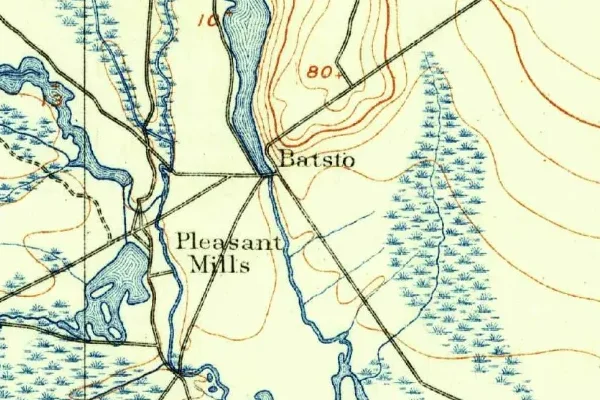
Batsto on the old USGS survey, and what the record holds around it
Within five miles the record maps 13 mine shafts, adits and prospect pits, 1 named mineral sites, 0 lost places and 1 cemeteries. Pro puts them on the map with the 1879–1919 survey underneath and a swipe to today.
From the archives

Vegetation, Batsto Historic Village, Batsto, New Jersey

Woods walk; Cemetery visit, Egg Harbor City, New Jersey; Batsto visit, Batsto, New Jersey

Jim Stasz, Batsto nature center, Martha's Bog, Batsto, New Jersey

The Batsto Mansion in the historic village of Batsto in the Pine Barrens of New Jersey
Batsto turns up on 336 digitized newspaper pages from New Jersey — read them free in the Library of Congress's Chronicling America collection.
Source: Library of Congress digital collections.
Questions from the field
- What is bog iron?
- Iron oxide that precipitates naturally in acidic Pine Barrens streams — raked up, smelted with charcoal, and good enough to supply the Revolution until coal-fired furnaces made it obsolete.
From the field
The most valuable part of this record is the part only visitors can write.
Stamp your passport
Check in at Batsto — GPS-verified visits earn an inked stamp.
File a field report
Road conditions, what's still standing, what's gone — your report joins the record.
Add photographs
Credited, dated, and preserved as part of Batsto's permanent record.
No field reports yet — sign in to file the first.
Primary sources for this record
- — USGS GNIS feature 874539
- — NJ DEP — Batsto Village / Wharton State Forest
- — Revolutionary War ordnance records