The story
Dogtown was Cape Ann's inland commons settlement, farmed from the 1690s until Gloucester's rebound to the profitable sea drained it after the Revolution. Its last decades belonged to widows, outcasts, and reputed witches — and to the feral dogs that named it; the final resident was carted to the poorhouse in 1830.
Two afterlives made it famous: painter Marsden Hartley's brooding boulder landscapes, and financier Roger Babson, who in the 1930s hired unemployed quarrymen to carve improving slogans into the glacial erratics — HELP MOTHER, NEVER TRY NEVER WIN, GET A JOB. Wandering the cellar holes among commanding rocks remains one of the strangest historical walks in America.
What remains today
Numbered cellar holes along the old roads, the Babson inscription boulders, and 3,600 acres of watershed woods.
Society Pro
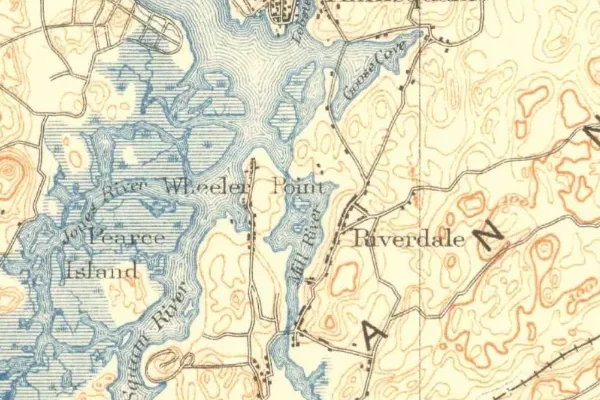
Dogtown on the old USGS survey, and what the record holds around it
Within five miles the record maps 14 mine shafts, adits and prospect pits, 8 named mineral sites, 7 lost places and 22 cemeteries. Pro puts them on the map with the 1879–1919 survey underneath and a swipe to today.
From the archives
Dogtown turns up on 1,667 digitized newspaper pages from Massachusetts — read them free in the Library of Congress's Chronicling America collection.
Source: Library of Congress digital collections.
Questions from the field
- What are the Babson Boulders?
- Two dozen glacial boulders carved with motivational commands, commissioned by Roger Babson during the Depression as make-work for quarrymen — Depression-era land art in a colonial ghost village.
From the field
The most valuable part of this record is the part only visitors can write.
Stamp your passport
Check in at Dogtown — GPS-verified visits earn an inked stamp.
File a field report
Road conditions, what's still standing, what's gone — your report joins the record.
Add photographs
Credited, dated, and preserved as part of Dogtown's permanent record.
No field reports yet — sign in to file the first.
Primary sources for this record
- — Gloucester/Cape Ann historical societies
- — Babson boulder project records
- — Colonial commons settlement studies