The story
Shawneetown was the Ohio River gateway to early Illinois — one of the state's first chartered towns, its land office and banks financing the frontier. Local legend insists its bankers once refused a loan to a swampy upstart called Chicago on the grounds it was too far from Shawneetown to amount to anything; historians wince, the town tells it anyway.
The river flooded it relentlessly, and after the catastrophic 1937 flood put the town under twenty feet of water, the WPA moved Shawneetown wholesale to the bluffs three miles inland. A hundred-odd residents stayed behind the levee among the survivors — chief among them the monumental 1839 Greek Revival bank, five stone columns of frontier ambition standing in a floodplain village.
What remains today
The 1839 First State Bank (state historic site), a scatter of occupied and empty buildings, and the levee that came too late.
Society Pro
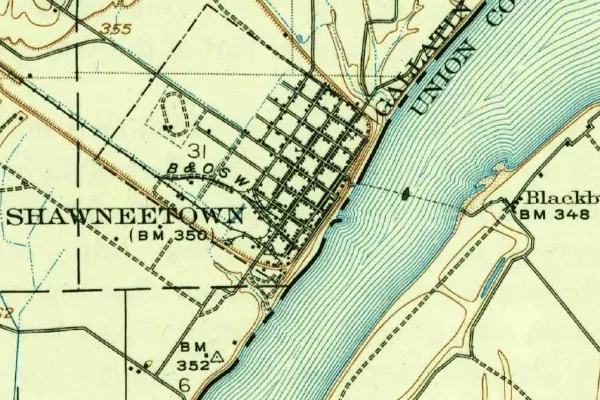
Old Shawneetown on the old USGS survey, and what the record holds around it
Within five miles the record maps 2 mine shafts, adits and prospect pits, 3 named mineral sites, 6 lost places and 4 cemeteries. Pro puts them on the map with the 1879–1919 survey underneath and a swipe to today.
From the archives
Old Shawneetown turns up on 603 digitized newspaper pages from Illinois — read them free in the Library of Congress's Chronicling America collection.
Source: Library of Congress digital collections.
Questions from the field
- Did Shawneetown really refuse Chicago a loan?
- It's a beloved legend with no solid documentation — but the bank's 1839 columns are real, and so is the reversal of fortunes the story exists to explain.
From the field
The most valuable part of this record is the part only visitors can write.
Stamp your passport
Check in at Old Shawneetown — GPS-verified visits earn an inked stamp.
File a field report
Road conditions, what's still standing, what's gone — your report joins the record.
Add photographs
Credited, dated, and preserved as part of Old Shawneetown's permanent record.
No field reports yet — sign in to file the first.
Primary sources for this record
- — USGS GNIS feature 415059
- — Illinois Historic Preservation — Shawneetown Bank
- — 1937 Ohio River flood records / WPA relocation