The story
Auraria was the boomtown of the Georgia Gold Rush, which drew thousands of prospectors onto former Cherokee land after the state's 1832 land lottery. A cabin went up that June, and within six months the place had roughly a hundred dwellings, a couple dozen stores, a stack of law offices, and several taverns. By May 1833 about a thousand people lived in town and ten thousand in the county. Its name comes from the Latin 'aurum,' for gold; earlier it went by rougher names like Nuckollsville and Scuffle Town.
Two things emptied it. First it lost the new county seat to nearby Dahlonega in 1833, which pulled business and officialdom four miles up the road. Then the California strike of 1849 drew Georgia's miners west en masse, and the shallow local diggings could not compete. Auraria dwindled as Dahlonega grew.
It never fully vanished. A handful of residents remain, and the old Graham Hotel — later Woody's store — still stands along Auraria Road southwest of Dahlonega, a weathered survivor of the first major gold rush east of the Mississippi.
What remains today
The Graham Hotel / Woody's store building, the Auraria Baptist Church, a few houses, and old mine scars along Auraria Road.
Society Pro
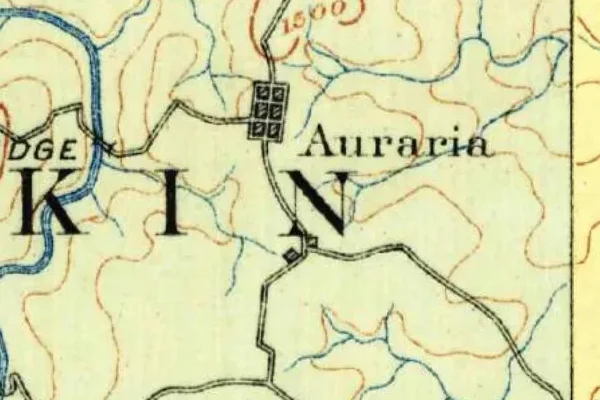
Auraria on the old USGS survey, and what the record holds around it
Within five miles the record maps 3 mine shafts, adits and prospect pits, 51 named mineral sites, 6 lost places and 2 cemeteries. Pro puts them on the map with the 1879–1919 survey underneath and a swipe to today.
From the archives
Auraria turns up on 780 digitized newspaper pages from Georgia — read them free in the Library of Congress's Chronicling America collection.
Source: Library of Congress digital collections.
Questions from the field
- Why did Auraria decline?
- It lost the Lumpkin County seat to Dahlonega in 1833, and then the 1849 California Gold Rush drew its miners west, leaving the shallow local diggings unable to sustain the town.
From the field
The most valuable part of this record is the part only visitors can write.
Stamp your passport
Check in at Auraria — GPS-verified visits earn an inked stamp.
File a field report
Road conditions, what's still standing, what's gone — your report joins the record.
Add photographs
Credited, dated, and preserved as part of Auraria's permanent record.
No field reports yet — sign in to file the first.
Primary sources for this record
- — USGS GNIS feature 354415
- — New Georgia Encyclopedia — Georgia Gold Rush
- — Lumpkin County historical records